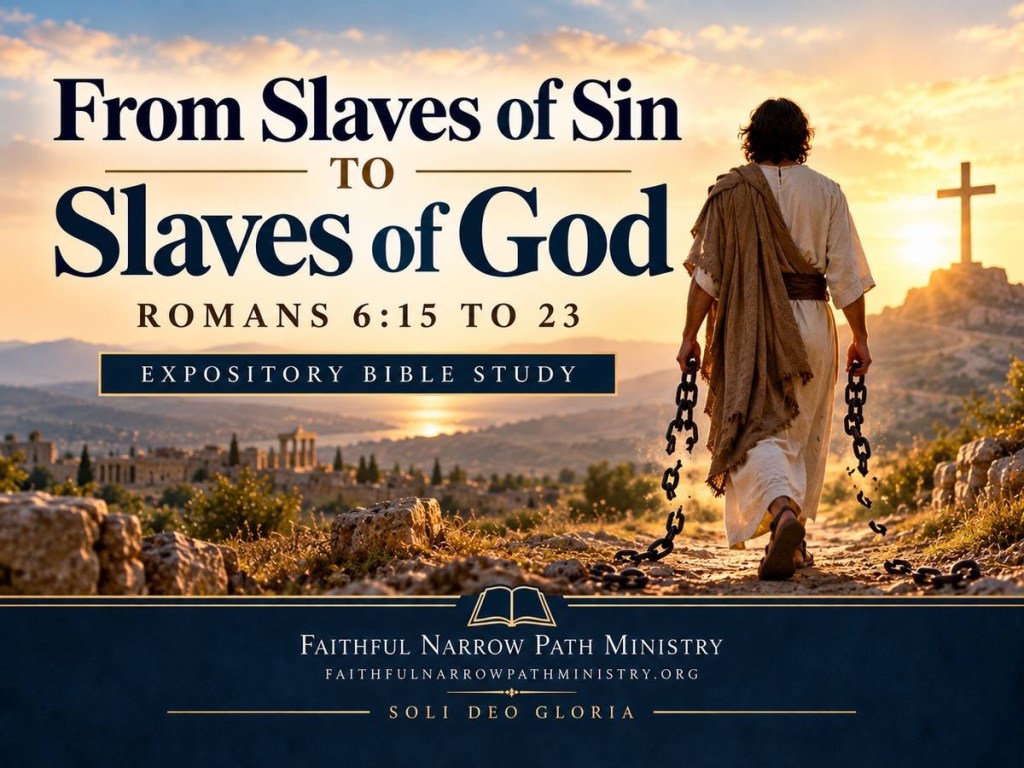
From Slaves of Sin to Slaves of God | Romans 6:15 to 23
Study Type: Expository Bible Study
Romans 6:15 to 23 confronts a dangerous misunderstanding of grace.
If salvation is by grace and not by works, does that mean obedience no longer matters?
Paul’s answer is emphatic.
Grace does not free believers to remain under the rule of sin. Those united to Christ have been brought out of slavery to sin and into a new life of obedience to God. Sanctification does not earn acceptance with God, but it is the necessary fruit of belonging to Him.
The passage ends with one of the clearest contrasts in Scripture:
Sin pays wages.
God gives a gift.
Death is earned.
Eternal life is given in Christ.
Scripture Reading
Romans 6:15 to 23 (ESV)
[15] What then? Are we to sin because we are not under law but under grace? By no means! [16] Do you not know that if you present yourselves to anyone as obedient slaves, you are slaves of the one whom you obey, either of sin, which leads to death, or of obedience, which leads to righteousness? [17] But thanks be to God, that you who were once slaves of sin have become obedient from the heart to the standard of teaching to which you were committed, [18] and, having been set free from sin, have become slaves of righteousness. [19] I am speaking in human terms, because of your natural limitations. For just as you once presented your members as slaves to impurity and to lawlessness leading to more lawlessness, so now present your members as slaves to righteousness leading to sanctification.
[20] For when you were slaves of sin, you were free in regard to righteousness. [21] But what fruit were you getting at that time from the things of which you are now ashamed? For the end of those things is death. [22] But now that you have been set free from sin and have become slaves of God, the fruit you get leads to sanctification and its end, eternal life. [23] For the wages of sin is death, but the free gift of God is eternal life in Christ Jesus our Lord.
Historical Context
Paul wrote Romans to believers in Rome, a church made up of both Jewish and Gentile Christians.
Throughout the letter, Paul explains the gospel with unusual depth and clarity.
He has already established that all people are under sin.
He has shown that justification comes by grace through faith apart from works of the law.
He has explained that believers are counted righteous through faith in Christ.
That naturally raises questions.
If righteousness is given by grace, what place does obedience have?
If believers are no longer under law in the same covenantal sense, does that mean sin no longer matters?
Romans 6 answers those objections.
Paul does not retreat from grace.
He shows what grace actually does.
Literary Context
Romans 6:15 to 23 should be read as the continuation of the argument beginning in Romans 6:1.
Earlier Paul asks:
“Are we to continue in sin that grace may abound?”
Romans 6:1 (ESV)
His answer is:
“By no means!”
Why?
Because believers have been united to Christ in His death and resurrection.
Romans 6:1 to 14 establishes the foundation.
Believers have died with Christ.
They have been raised to newness of life.
Sin no longer has the same dominion over them.
Then verse 15 raises a related question:
If believers are not under law but under grace, does that mean sin is now permitted?
Again Paul answers:
“By no means!”
The second half of Romans 6 explains that grace changes not only our legal standing but also our master, allegiance, and direction.
Romans 6:15
Shall We Sin Because We Are Under Grace?
Paul asks:
“Are we to sin because we are not under law but under grace?”
The question exposes a serious distortion of the gospel.
If salvation is not earned by obedience, someone may conclude that obedience no longer matters.
Paul rejects that reasoning immediately.
“By no means!”
Grace is not permission to rebel against God.
Grace rescues people from rebellion.
The gospel does not say:
Sin freely because forgiveness is available.
The gospel says:
You have been brought under grace, therefore do not return willingly to the master from whom you have been delivered.
Not Under Law but Under Grace
This phrase must be handled carefully.
Paul does not mean believers are now morally autonomous.
He does not mean God’s holiness has changed.
He does not mean His moral will no longer matters.
Rather, believers are no longer under the law as the covenantal regime that condemns sinners and cannot provide the righteousness they need.
They are under grace.
Grace does what law alone cannot do.
It justifies the ungodly.
It unites believers to Christ.
It gives new life.
And it begins producing obedience from the heart.
Grace Does Not Produce Lawlessness
One of the persistent errors in Christian thought is antinomianism.
Antinomianism treats grace as though it cancels the importance of obedience.
Paul will not allow that.
Grace and holiness are not enemies.
Grace is the source of true holiness.
Paul does not say:
You are under grace, therefore obedience is unnecessary.
He says:
You are under grace, therefore sin must no longer rule you.
Romans 6:16
Everyone Serves a Master
Paul continues:
“Do you not know that if you present yourselves to anyone as obedient slaves, you are slaves of the one whom you obey?”
Paul uses the language of slavery to expose the reality of moral allegiance.
Human beings are not spiritually neutral.
We do not simply drift between independence and servitude.
Everyone serves a master.
Paul identifies two paths:
sin, which leads to death
and
obedience, which leads to righteousness.
His point is not that obedience earns justification.
His point is that the master we serve reveals the realm to which we belong.
Sin Is a Master
Modern people often think of sin primarily as individual bad choices.
Paul goes deeper.
Sin is pictured as a ruling power.
It commands.
It enslaves.
It produces obedience to itself.
Sin promises freedom while producing bondage.
A person may imagine:
I am free because I can do what I want.
But if what we want is governed by sinful desire, that is not true freedom.
It is slavery wearing the appearance of autonomy.
Romans 6:17
Obedient From the Heart
Paul then gives thanks to God:
“But thanks be to God, that you who were once slaves of sin have become obedient from the heart.”
Notice who receives the praise.
Paul does not say:
Thanks be to you because you finally improved yourselves.
He says:
“thanks be to God.”
The change in these believers is evidence of divine grace.
They were:
“once slaves of sin.”
But something has changed.
They have become:
“obedient from the heart.”
The Heart Has Changed
This phrase is important.
Paul is not describing mere external conformity.
He says:
“from the heart.”
The gospel produces an inward change.
The believer does not simply receive a new list of rules.
Grace changes the disposition of the person.
That does not mean believers obey perfectly.
Romans itself will later describe the struggle with remaining sin.
But there is now a new orientation.
The believer increasingly wants what God wants.
The commands of God are no longer merely external demands pressing against an entirely hostile heart.
Grace begins creating willing obedience.
Regeneration and Obedience
Theologically, this points us toward regeneration.
A sinner enslaved to sin does not simply need better information.
He needs new life.
Scripture repeatedly describes salvation in terms of:
new birth,
a new heart,
being made alive,
and becoming a new creation.
Paul’s phrase:
“obedient from the heart”
fits that wider biblical picture.
True Christian obedience grows from an inward work of grace.
Romans 6:17
The Standard of Teaching
Paul says they became obedient:
“to the standard of teaching to which you were committed.”
Christian obedience is not vague spirituality.
It is shaped by revealed truth.
Grace does not free believers from doctrine.
Grace brings them under the truth of the gospel and the teaching of Christ.
Believers do not invent their own definition of obedience.
God’s Word defines it.
That means doctrine and life cannot be separated.
What we believe shapes how we live.
Romans 6:18
Set Free From Sin
Paul continues:
“and, having been set free from sin, have become slaves of righteousness.”
This is one of the clearest descriptions of the believer’s change of realm.
Paul does not say believers are now free from the presence of sin.
That would contradict Christian experience and Paul’s later teaching.
He says they have been:
“set free from sin”
in the sense that sin is no longer their rightful master.
Its dominion has been broken.
Its authority has been decisively challenged.
Believers still battle sin.
But they no longer belong to sin.
Slaves of Righteousness
Paul then uses deliberately strong language:
“slaves of righteousness.”
This does not mean believers earn righteousness through obedience.
Paul has already made clear throughout Romans that justification is by grace through faith.
Rather, the image describes a new allegiance.
The believer has been transferred from one master to another.
Once enslaved to sin.
Now bound to righteousness.
Once under the dominion of rebellion.
Now under the lordship of God.
Freedom Is Not Independence From God
The biblical idea of freedom is different from the modern idea of absolute autonomy.
True freedom is not independence from God.
Independence from God is precisely what led humanity into slavery to sin.
True freedom is liberation from sin so that we can belong to God and live according to the purpose for which we were created.
The believer is most free when living under the gracious rule of God.
Romans 6:19
Paul’s Slavery Analogy
Paul briefly explains his language:
“I am speaking in human terms, because of your natural limitations.”
Paul knows the slavery metaphor has limitations.
He is using a familiar human institution to communicate spiritual reality.
That means we should not press every aspect of historical slavery into the theological comparison.
Paul’s central point is allegiance and mastery.
Sin once ruled them.
Now righteousness must shape their lives.
Present Your Members to Righteousness
Paul says:
“just as you once presented your members as slaves to impurity and to lawlessness leading to more lawlessness, so now present your members as slaves to righteousness leading to sanctification.”
Notice the progression.
Sin does not remain static.
Impurity leads to further lawlessness.
Sin grows.
Sin hardens.
Sin produces more sin.
But Paul now describes an opposite movement.
Present yourselves to righteousness.
And righteousness leads toward:
“sanctification.”
Sanctification Is the Fruit
This is crucial.
Paul does not say sanctification is the basis of justification.
He has already established justification by faith.
Here he is describing the life that follows.
The believer has been set free from sin.
Now that new identity begins bearing fruit.
Sanctification is not payment for salvation.
It is the fruit of salvation.
Grace changes both status and direction.
Romans 6:20
When You Were Slaves of Sin
Paul asks the Romans to remember their former condition.
“For when you were slaves of sin, you were free in regard to righteousness.”
That kind of freedom is not something to celebrate.
It means righteousness had no governing claim in their lives.
They were free from righteousness only in the sense that they were enslaved to something worse.
Paul is exposing the emptiness of sinful independence.
Romans 6:21
What Fruit Did Sin Produce?
Paul then asks:
“But what fruit were you getting at that time from the things of which you are now ashamed?”
This is a deeply practical question.
Sin makes promises.
What does it actually produce?
Paul says the end of those things is:
“death.”
Sin may provide temporary pleasure.
Temporary approval.
Temporary power.
Temporary escape.
But its final fruit is death.
Paul calls believers to look honestly at the outcome of the life they once lived.
Shame and Repentance
Paul’s reference to shame should not be misunderstood as unhealthy psychological condemnation.
There is a difference between godly recognition of sin and destructive hopelessness.
The believer can look back and say:
That was sinful.
That was shameful.
That led toward death.
But the believer does not remain trapped in condemnation.
Why?
Because Romans has already declared:
“There is therefore now no condemnation for those who are in Christ Jesus.”
Romans 8:1 (ESV)
Grace allows believers to face the truth about sin without being destroyed by it.
Romans 6:22
Now That You Have Been Set Free
Paul now contrasts their present condition:
“But now that you have been set free from sin and have become slaves of God…”
Again, the language is decisive.
The Christian life involves a real transfer.
Once slaves of sin.
Now slaves of God.
Once belonging to the realm of death.
Now belonging to the God who gives life.
The Fruit You Get Leads to Sanctification
Paul continues:
“the fruit you get leads to sanctification and its end, eternal life.”
Notice again the order.
Believers have already been set free.
They have already become slaves of God.
Then comes fruit.
Then sanctification.
Then the final consummation:
eternal life.
Sanctification is not presented as the purchase price of eternal life.
It is the necessary fruit along the path of those whom God has rescued.
Perseverance and Sanctification
This gives us an important theological synthesis.
Those whom God saves, He does not leave unchanged.
Grace not only justifies.
Grace sanctifies.
The believer’s growth may be uneven.
There may be serious struggles.
There may be seasons of weakness.
But the overall direction has changed.
God preserves His people, and His preserving grace produces persevering faith and growing holiness.
Sanctification is therefore necessary, not because it earns eternal life, but because it belongs to the saving work God completes in His people.
Romans 6:23
The Wages of Sin
Paul closes the passage with one of the clearest contrasts in Scripture:
“For the wages of sin is death.”
A wage is something earned.
Sin pays what it owes.
And its payment is death.
Paul has been making that point throughout the passage.
Sin leads to death.
The fruit of sin ends in death.
Now he summarizes it.
Death is not an arbitrary penalty disconnected from sin.
It is the fitting outcome of rebellion against the God who is the source of life.
The Free Gift of God
Then comes the contrast:
“but the free gift of God is eternal life in Christ Jesus our Lord.”
Paul does not say:
The wages of righteousness are eternal life.
That would destroy the gospel.
He says:
“the free gift of God.”
The contrast is deliberate.
Sin earns wages.
God gives a gift.
Death is deserved.
Eternal life is given by grace.
Eternal Life Is in Christ
Paul also identifies where this gift is found:
“in Christ Jesus our Lord.”
Eternal life is not an abstract spiritual commodity.
It is found in union with Christ.
Christ is the One who died.
Christ is the One who rose.
Christ is the One in whom believers have new life.
The gift cannot be separated from the Giver.
Law and Gospel
Romans 6:23 gives us a powerful law and gospel contrast.
The law exposes what sin deserves.
“the wages of sin is death.”
The gospel announces what God gives freely.
“the free gift of God is eternal life.”
That does not mean obedience disappears.
The entire passage has insisted upon obedience and sanctification.
But obedience never becomes the ground of the gift.
Eternal life remains grace from beginning to end.
Union With Christ Is the Foundation
The entire passage rests upon what Paul established earlier in Romans 6.
Believers have been united to Christ.
They died with Him.
They were raised with Him.
Therefore they must not present themselves again to sin as though nothing has changed.
Christian obedience is not merely behavior modification.
It flows from a new identity.
Believers obey because they belong to Christ.
Grace Changes Masters
That gives us the central movement of the passage.
Grace does not simply cancel guilt while leaving the sinner under the same master.
Grace transfers allegiance.
Sin once ruled.
Now God rules.
Sin once produced death.
Now righteousness produces the fruit of sanctification.
Sin paid wages.
God gives life.
The Christian has not merely received a second chance.
The Christian has been brought into a new realm under a new Lord.
Justification and Sanctification
Romans 6:15 to 23 helps us keep justification and sanctification together without confusing them.
Justification answers the question:
How is a sinner declared righteous before God?
By grace through faith in Christ.
Sanctification answers the question:
What happens to those whom God has justified?
They are increasingly transformed into lives of holiness and obedience.
Sanctification does not earn justification.
But justification does not produce a permanently unchanged life.
The same grace that pardons also transforms.
Obedience From the Heart
One of the most important phrases in this passage is:
“obedient from the heart.”
Christian obedience is not merely external conformity.
It is the fruit of inward renewal.
That does not mean motives are always perfect.
It does not mean obedience is complete.
It means there is a new direction.
The believer increasingly wants to please God.
That desire itself is evidence of grace at work.
The Believer Still Battles Sin
Being set free from sin does not mean the battle is over.
Paul will speak later about the continuing struggle with sin.
But there is a difference between:
sin remaining
and
sin reigning.
Sin remains in believers.
But it no longer possesses the same dominion.
Christ is Lord.
That is why Christians can resist sin at all.
Core Truth
Grace does not free believers to remain under sin’s rule. Through union with Christ, believers have been transferred from slavery to sin into willing obedience to God. Sanctification is the necessary fruit of that new life, while eternal life remains the free gift of God in Christ Jesus.
Sin enslaves.
Grace liberates.
Sin pays wages.
God gives life.
Obedience is fruit.
Christ is the foundation.
What Master Are You Serving?
Paul’s slavery language forces a question.
Who is actually ruling your life?
The answer is not found merely in what we say.
It is revealed over time in what we obey.
What commands your attention?
What controls your desires?
What do you repeatedly surrender to?
What do you defend even when Scripture confronts it?
Everyone serves a master.
Paul’s question is not whether you will serve.
It is whom you serve.
Do Not Confuse Struggle With Slavery
This passage can also be misunderstood by sincere believers.
A Christian who struggles with sin may think:
If I still struggle, maybe I am still a slave to sin.
But struggle itself can be evidence that something has changed.
The slave of sin does not ultimately oppose his master.
The believer does.
Christians grieve sin.
Fight sin.
Confess sin.
Return to Christ.
The presence of battle does not prove the absence of grace.
What matters is that sin is no longer embraced as the rightful master.
Grace Does Not Lower the Standard
Grace does not make holiness less important.
It makes holiness possible.
Paul does not respond to justification by grace by lowering God’s moral standard.
He calls believers to present themselves to righteousness.
The difference is that obedience now flows from grace rather than an attempt to earn grace.
Application
Romans 6:15 to 23 asks several direct questions.
Have I begun treating grace as permission to excuse a pattern of sin?
What does the actual fruit of my sin produce?
Am I trying to obey God in order to earn acceptance, or because I already belong to Him in Christ?
Is my obedience increasingly coming from the heart rather than merely from outward pressure?
Where am I still presenting myself to habits, desires, or patterns that belong to my former master?
Do I see sanctification as optional, or as the necessary fruit of God’s saving work?
Do I truly understand the difference between wages and gift?
Progress
Christian growth is a continuing movement of presenting ourselves to God.
We do not graduate from dependence upon grace.
We become increasingly aware of how much we need it.
But grace does not leave us passive.
We learn to identify sin more quickly.
We become less willing to excuse it.
We grow in obedience.
We increasingly present our bodies, minds, habits, relationships, time, and priorities to God.
Sanctification is often gradual.
But grace produces movement.
Encouragement
Perhaps you are discouraged because sin still feels powerful.
Romans 6 does not tell believers that sin is imaginary.
It tells them something better.
Sin is no longer your rightful master.
Christ is.
You may struggle.
You may stumble.
You may have to repent repeatedly.
But if you belong to Christ, your identity is not:
slave of sin.
Paul says:
“you have been set free from sin.”
That does not mean the battle is easy.
It means the battle is no longer hopeless.
Challenge and Reflection
Consider Paul’s contrasts.
Sin or obedience.
What are you presenting yourself to?
Old slavery or new allegiance.
What master shapes the direction of your life?
Lawlessness or sanctification.
What fruit is your life increasingly producing?
Wages or gift.
Are you trying to earn from God what He gives freely in Christ?
And finally:
Do you understand grace as freedom from sin’s dominion, or merely freedom from sin’s consequences?
Paul’s answer is clear.
Grace does both.
It pardons.
And it transforms.
Closing Charge
Romans 6:15 to 23 destroys the idea that grace makes obedience irrelevant.
Grace does not leave believers under the same master.
It sets them free.
Once slaves of sin.
Now slaves of righteousness.
Once producing fruit that ended in death.
Now producing fruit that leads to sanctification.
Once under the wages of sin.
Now receiving the free gift of God.
So do not return willingly to the master from whom Christ has delivered you.
Do not use grace as an excuse for sin.
Do not turn sanctification into a way of earning salvation.
Present yourself to God.
Pursue obedience from the heart.
Fight sin as one who no longer belongs to it.
And remember the final contrast:
The wages of sin is death.
But the free gift of God is eternal life in Christ Jesus our Lord.
Soli Deo Gloria
To God alone be the glory.
Scriptures Referenced
Primary Passage: Romans 6:15 to 23
Supporting Passages: John 8:34 to 36, Romans 3:21 to 28, Romans 5:12 to 21, Romans 6:1 to 14, Romans 7:14 to 25, Romans 8:1 to 14, 1 Corinthians 6:9 to 11, 2 Corinthians 5:17, Galatians 5:13 to 25, Ephesians 2:1 to 10, Titus 2:11 to 14

Leave a comment