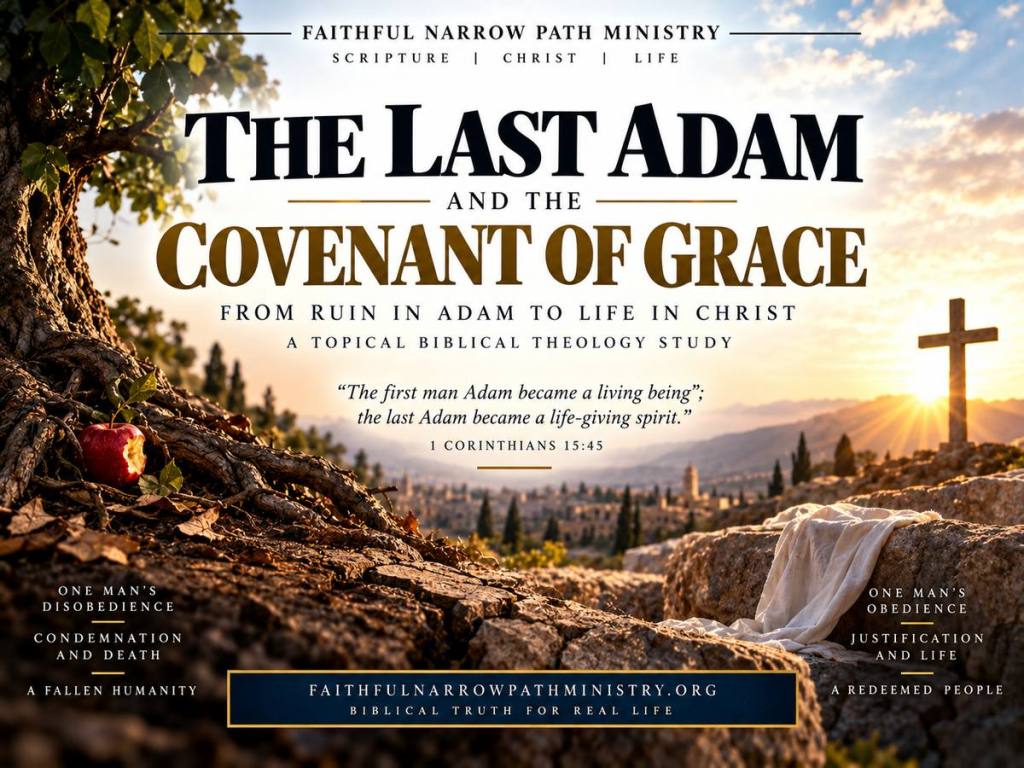
The Last Adam and the Covenant of Grace | From Ruin in Adam to Life in Christ
Study Type: Topical Biblical Theology
The Bible presents humanity’s problem and God’s saving work through two representative heads: Adam and Jesus Christ.
Through Adam came sin, condemnation, corruption, and death. Through Christ come righteousness, justification, resurrection, and life.
This study traces that contrast from Genesis through Romans and 1 Corinthians, showing how God’s gracious purpose of redemption unfolds after the fall and reaches its fulfillment in Jesus Christ, the One Paul calls “the last Adam.”
The phrase Covenant of Grace is a theological description rather than a phrase Scripture uses directly. It summarizes the one gracious saving purpose of God that unfolds throughout redemptive history and reaches its fulfillment in Christ.
Likewise, Scripture calls Jesus “the last Adam” in 1 Corinthians 15:45 and “the second man” in verse 47. “Second Adam” is useful theological shorthand, but Paul’s own wording is more precise.
Key Passages
Genesis 2:15 to 17
Genesis 3:1 to 24
Romans 5:12 to 21
1 Corinthians 15:20 to 23
1 Corinthians 15:45 to 49
Galatians 3:6 to 29
Ephesians 1:3 to 14
Ephesians 2:1 to 10
Hebrews 9:15
Hebrews 12:24
We encourage you to read each of the key passages in full as you work through this study. Selected verses are quoted throughout, but the broader passages should be read in their complete biblical context.
Before the Fall
Genesis begins with humanity created by God and placed within a good creation.
Adam is created in the image of God and given a particular responsibility.
Genesis 2 records God placing Adam in the garden and commanding him concerning the tree of the knowledge of good and evil.
The command is clear.
Adam may freely eat from the trees of the garden, but he must not eat from that particular tree.
God attaches a consequence to disobedience:
“you shall surely die.”
Genesis 2:17 (ESV)
Adam therefore stands before God under a real obligation.
He is not autonomous.
Life with God includes trusting God’s Word, receiving His provision, and obeying His command.
The Covenant of Works
Theologically, God’s arrangement with Adam is commonly described as the Covenant of Works, sometimes called the Covenant of Life.
Genesis 2 itself does not explicitly use the word covenant for this arrangement.
The term summarizes the biblical structure of the relationship.
Adam receives a command.
Disobedience carries the sanction of death.
Later Scripture treats Adam’s act as having consequences far beyond Adam himself.
The important point is not the label by itself.
The important point is the biblical reality behind it.
Adam stands before God not merely as an isolated individual, but as the representative head of humanity.
Adam as Representative Head
Paul makes this especially clear in Romans 5.
He does not describe Adam merely as a bad example whom later people happen to imitate.
Paul says:
“sin came into the world through one man, and death through sin.”
Romans 5:12 (ESV)
Later:
“one trespass led to condemnation for all men.”
Romans 5:18 (ESV)
And again:
“by the one man’s disobedience the many were made sinners.”
Romans 5:19 (ESV)
Adam’s act has representative significance.
The theological term often used for this is federal headship.
“Federal” simply means representative.
Adam stands at the head of fallen humanity.
His disobedience has consequences for those he represents.
This does not mean later human beings are innocent except for Adam.
We also sin willingly ourselves.
But Paul’s argument goes deeper than imitation.
Humanity is already a fallen humanity in Adam.
The Fall
Genesis 3 records Adam and Eve’s rebellion.
The serpent questions God’s Word.
Eve takes the forbidden fruit.
Adam eats.
And the consequences begin immediately.
Shame enters.
Fellowship is disrupted.
Human relationships are corrupted.
Creation is subjected to frustration.
And death enters the human story.
What happened in the garden was not a minor mistake.
Humanity rejected the authority of the Creator.
Adam chose the serpent’s word over God’s Word.
The result was precisely what God had warned.
Death.
Sin and Death in Adam
Romans 5 explains the theological significance of Genesis 3.
Paul writes:
“by the one man’s disobedience the many were made sinners.”
Romans 5:19 (ESV)
Our problem is therefore deeper than bad habits.
Human beings are not born morally neutral and then become sinners only because they copy other sinners.
We enter the world as members of a fallen humanity.
Adam’s representative act brings condemnation.
The corruption of sin extends throughout the human race.
Death reigns.
And every one of us confirms our fallen condition through our own sin.
This is what Christians commonly call original sin.
We are sinners by nature and sinners by action.
Judgment Is Not the End of Genesis 3
Yet even in the chapter describing humanity’s fall, judgment is not the final word.
Genesis 3:15 contains an extraordinary promise.
God announces hostility between the serpent and the woman and between their offspring.
The offspring of the woman will ultimately crush the serpent.
Genesis 3:15 does not contain the entire New Testament gospel in fully developed form.
We should not force later details back into the verse.
But from the perspective of the completed biblical canon, the promise begins a redemptive trajectory that ultimately leads to Jesus Christ.
Humanity has fallen in Adam.
Yet God announces that the serpent will not finally prevail.
A victorious offspring will come.
Grace Begins to Shine
This is where the biblical story begins moving from ruin toward redemption.
Adam has failed.
Humanity cannot reverse what has happened.
Death has entered.
Sin has corrupted.
No human effort can simply restore Eden.
If sinners are going to be rescued, God must act.
And He does.
From Genesis onward, Scripture unfolds God’s saving purpose through promise and covenant.
That redemptive purpose develops through Noah, Abraham, Israel, David, and the prophets before reaching its fulfillment in Jesus Christ.
This one unfolding saving purpose is what theology commonly calls the Covenant of Grace.
What Is the Covenant of Grace?
The phrase Covenant of Grace does not appear verbatim in Scripture.
It is a theological category used to describe the unity of God’s gracious saving purpose after the fall.
The basic idea is this:
God graciously saves fallen sinners through Jesus Christ rather than sinners rescuing themselves through their own works.
That saving purpose unfolds progressively through redemptive history.
God does not reveal everything at once.
The promises become clearer.
The covenant structures develop.
The identity of the coming Redeemer becomes increasingly specific.
But the way of salvation does not change from one method into another.
There has never been one way of salvation for Old Testament believers and a completely different way for New Testament believers.
Fallen sinners have always depended upon the grace and mercy of God.
One Plan of Salvation
Abraham was not justified because he perfectly obeyed God.
Genesis 15 says:
“he believed the LORD, and he counted it to him as righteousness.”
Genesis 15:6 (ESV)
Paul later uses Abraham to explain justification by faith.
David likewise depended upon divine mercy.
The sacrificial system continually testified that sin required atonement and that sinners could not simply declare themselves righteous.
Old Testament believers did not possess the fullness of revelation that came with Christ.
But they trusted the promises God had revealed.
The saving work those promises anticipated comes into full clarity in Jesus Christ.
There are not two gospels.
There is one gracious redemptive purpose progressively revealed and ultimately accomplished in Christ.
The Promise Moves Forward
After Genesis 3, the promise becomes increasingly specific.
God promises Abraham offspring, a people, land, and blessing to the nations.
The promise moves through Isaac.
Then Jacob.
Then Judah.
Later God promises David an enduring royal line.
The prophets speak of a coming Servant, King, Shepherd, Redeemer, and covenant mediator.
Each development adds greater clarity.
Yet the central problem remains unchanged.
Humanity remains fallen in Adam.
Sin reigns.
Death reigns.
A new representative is needed.
Adam and Christ in Romans 5
Romans 5:12 to 21 is one of the most important passages for understanding the relationship between Adam and Christ.
Paul deliberately places the two men opposite one another.
Adam is the representative of fallen humanity.
Christ is the representative of redeemed humanity.
Paul says Adam:
“was a type of the one who was to come.”
Romans 5:14 (ESV)
Adam points forward to Christ, not because they are morally alike, but because both function representatively.
What one man does has consequences for those he represents.
One Trespass and One Act of Righteousness
Paul contrasts Adam and Christ repeatedly.
Through Adam:
sin enters.
condemnation comes.
death reigns.
many are made sinners.
Through Christ:
grace abounds.
justification comes.
righteousness is provided.
life reigns.
many are made righteous.
Romans 5:18 says:
“as one trespass led to condemnation for all men, so one act of righteousness leads to justification and life.”
Romans 5:18 (ESV)
This parallel must be read within Paul’s larger argument.
Verse 17 speaks of:
“those who receive the abundance of grace and the free gift of righteousness.”
Paul is not teaching that every individual without exception is automatically justified.
The saving benefits of Christ belong to those represented by Him and united to Him.
The Obedience of Christ
Romans 5:19 says:
“by the one man’s obedience the many will be made righteous.”
Christ succeeds where Adam failed.
Adam was commanded to obey and disobeyed.
Christ comes in perfect obedience to the Father.
That obedience does not begin only at the cross.
Jesus lives a life of perfect righteousness.
He obeys where humanity has rebelled.
He fulfills the Father’s will.
And His obedience reaches its climactic expression in His willing submission unto death.
Philippians 2 says He became:
“obedient to the point of death, even death on a cross.”
Philippians 2:8 (ESV)
The Active Obedience of Christ
The theological phrase active obedience of Christ refers to Christ’s whole life of perfect obedience to the Father.
It does not mean Christ was active during His life but somehow passive at the cross.
Jesus fulfills righteousness.
He loves God perfectly.
He obeys faithfully.
He completes the work the Father gives Him.
His death then bears the judgment due to sinners.
Both dimensions matter.
We need more than the cancellation of guilt.
We need righteousness before God.
Christ is not merely the One who dies in our place.
He is the perfectly righteous representative of His people.
Imputation
Another important theological term is imputation.
Imputation means something being counted or reckoned to another.
Romans 5 teaches that Adam’s representative act results in condemnation for those he represents.
Christ’s obedience results in justification for those who belong to Him.
God does not declare sinners righteous by pretending sin does not matter.
Christ has satisfied divine justice.
His righteousness is sufficient for His people.
Our standing before God is therefore not grounded in our personal performance.
It is grounded in Christ.
Justification Is Not Sanctification
This distinction matters.
Justification is God’s declaration that the believer is righteous in Christ.
Sanctification is God’s continuing work of conforming believers to Christ.
We must not reverse the order.
We are not gradually sanctified until we eventually become righteous enough to be justified.
We are justified by grace through faith because of Christ.
Then the justified believer grows in holiness.
Good works matter.
Holiness matters.
Obedience matters.
But they are the fruit of salvation, not the price of salvation.
The Last Adam
Paul develops the Adam and Christ relationship again in 1 Corinthians 15.
He writes:
“The first man Adam became a living being”; the last Adam became a life-giving spirit.
1 Corinthians 15:45 (ESV)
Then:
“The first man was from the earth, a man of dust; the second man is from heaven.”
1 Corinthians 15:47 (ESV)
Notice Paul’s wording.
Jesus is the last Adam.
He is also the second man.
The title “last Adam” communicates something profound.
Christ is not one more representative who might fail.
He is the final representative head of redeemed humanity.
Adam failed.
Christ does not.
Death in Adam, Life in Christ
Paul writes:
“For as in Adam all die, so also in Christ shall all be made alive.”
1 Corinthians 15:22 (ESV)
This verse must be interpreted in context.
Verse 23 immediately identifies those who share Christ’s resurrection life as:
“those who belong to Christ.”
Paul is not teaching universal salvation.
The phrase “in Christ” is decisive.
Those represented by Adam share the death of fallen humanity.
Those who belong to Christ share the resurrection life of their risen representative.
Adam represents fallen humanity.
Christ represents His redeemed people.
Union With Christ
This brings us to one of the richest themes in the New Testament:
union with Christ.
Believers are repeatedly described as being:
in Christ.
That language expresses the believer’s saving participation in Christ and His benefits.
Because believers are united to Christ:
His death answers our condemnation.
His righteousness grounds our justification.
His resurrection guarantees our resurrection.
His life becomes the source of our new life.
His inheritance becomes ours in Him.
Salvation is not merely receiving benefits from a distant Savior.
It is belonging to Christ.
Two Humanities
Paul’s Adam and Christ theology gives us a profound way of understanding humanity.
There is humanity in Adam.
And there is humanity in Christ.
In Adam:
sin.
condemnation.
corruption.
death.
In Christ:
righteousness.
justification.
new life.
resurrection.
Christianity therefore cannot be reduced to moral improvement.
Our deepest need is not to become a slightly better version of fallen Adam.
We need a new representative.
We need to belong to Christ.
Grace Is Greater Than Adam’s Trespass
Romans 5 does not present Adam and Christ as equal powers.
Paul repeatedly emphasizes the superiority of grace.
He says:
“the free gift is not like the trespass.”
Romans 5:15 (ESV)
And:
“where sin increased, grace abounded all the more.”
Romans 5:20 (ESV)
Adam’s sin is devastating.
Death reigns because of it.
But Christ’s saving work is greater.
Grace does not merely bring believers back to a neutral starting point.
Those united to Christ receive righteousness, reconciliation, adoption, the Holy Spirit, and the promise of resurrection glory.
God’s grace does more than repair what Adam broke.
It carries His people toward the consummated glory secured in Christ.
The Covenant of Grace and the New Covenant
How does this relate to the New Covenant?
The Covenant of Grace and the New Covenant should not simply be treated as two names for exactly the same thing without qualification.
The Covenant of Grace is the theological category describing God’s one gracious saving purpose unfolding throughout redemptive history.
The New Covenant is the climactic covenantal administration established through Christ.
The earlier promises anticipate what Christ will accomplish.
The New Covenant brings those promises into decisive fulfillment.
Jesus says:
“This cup that is poured out for you is the new covenant in my blood.”
Luke 22:20 (ESV)
Christ is not merely another messenger announcing grace.
He establishes the New Covenant through His own blood.
Christ the Mediator
Hebrews identifies Jesus as:
“the mediator of a new covenant.”
Hebrews 9:15 (ESV)
Sinful humanity cannot reconcile itself to God.
We need a mediator.
Christ represents His people before God.
He offers the sufficient sacrifice.
He fulfills righteousness.
He bears judgment.
He rises from the dead.
And He mediates the covenant blessings His people could never secure for themselves.
The Last Adam is therefore also the mediator of the New Covenant.
From Adam to Christ
The storyline can now be seen clearly.
Adam
Humanity’s first representative fails.
The Fall
Sin, condemnation, corruption, and death enter.
Genesis 3:15
God promises that the serpent will ultimately be defeated.
Abraham
God promises offspring and blessing to the nations.
David
God promises a royal descendant and enduring kingdom.
The Prophets
God announces a coming Servant, King, Redeemer, and New Covenant.
Christ
The Last Adam comes.
He obeys.
He suffers.
He dies.
He rises.
He reigns.
And through Him the gracious saving purposes of God reach their fulfillment.
The Covenant of Grace Is Christ Centered
This is essential.
The Covenant of Grace is not ultimately about an abstract theological structure.
It is about Christ.
The promises lead to Christ.
The covenants anticipate Christ.
The sacrifices point toward Christ.
The priesthood prepares for Christ.
The kingdom points toward Christ.
The prophets announce Christ.
The New Covenant is established through Christ.
And every saving benefit comes to believers through union with Christ.
Covenant theology should therefore never move our attention away from Jesus.
Properly understood, it should drive us toward Him.
Not Salvation by Works in One Testament and Grace in Another
One misunderstanding needs to be rejected clearly.
The Old Testament does not teach salvation by works while the New Testament teaches salvation by grace.
After Adam’s fall, no sinner can establish righteousness before God through personal obedience.
The law exposes sin.
Sacrifices testify to the need for atonement.
The prophets repeatedly call sinners to God’s mercy.
The saints of the Old Testament lived by faith in the promises God had revealed.
Christ had not yet come in history, but His saving work is the ground upon which any sinner has ever been accepted by God.
The cross stands at the center of redemption even for those who lived before it historically occurred.
Election and Grace
Scripture also presents salvation as beginning with God’s gracious purpose, not human initiative.
Ephesians 1 says God chose His people in Christ:
“before the foundation of the world.”
Ephesians 1:4 (ESV)
Paul continues by speaking of adoption:
“according to the purpose of his will.”
Ephesians 1:5 (ESV)
Romans 8 likewise describes God’s saving purpose moving from foreknowledge and predestination to calling, justification, and glorification.
Ephesians 2 describes fallen humanity as:
“dead in the trespasses and sins.”
Ephesians 2:1 (ESV)
Then comes one of Scripture’s great reversals:
“But God.”
God acts.
God shows mercy.
God makes alive.
God raises.
God saves.
And Paul says:
“by grace you have been saved.”
Ephesians 2:5 (ESV)
Faith is necessary.
Scripture repeatedly commands sinners to believe.
But faith is never the meritorious cause of salvation.
Faith receives Christ.
The glory belongs to God.
The Holy Spirit and New Life
The transition from Adam to Christ also helps us understand regeneration.
Christ is called:
“a life-giving spirit.”
1 Corinthians 15:45 (ESV)
Paul is not identifying Christ with the person of the Holy Spirit.
The Father, Son, and Holy Spirit remain distinct persons within the Trinity.
Rather, the risen Christ is the source of resurrection life for His people, and that life is applied through the Holy Spirit.
The Spirit gives new life.
He unites believers to Christ.
He opens hearts to the gospel.
He produces the fruit of sanctification.
Salvation is therefore thoroughly Trinitarian.
The Father purposes redemption.
The Son accomplishes redemption.
The Holy Spirit applies redemption.
The Last Adam and Resurrection
The Last Adam theme reaches beyond justification.
It reaches all the way to bodily resurrection.
1 Corinthians 15 is fundamentally a resurrection chapter.
Adam gives us the pattern of earthly, mortal humanity.
Christ gives us the pattern of resurrected humanity.
Paul writes:
“Just as we have borne the image of the man of dust, we shall also bear the image of the man of heaven.”
1 Corinthians 15:49 (ESV)
The Christian hope therefore is not merely that our souls go somewhere better when we die.
Our hope includes bodily resurrection.
Christ has risen.
Those who belong to Him will rise.
The Last Adam guarantees the future of His people.
Core Truth
Humanity fell under sin, condemnation, and death through Adam, but God’s gracious redemptive purpose reaches its fulfillment in Jesus Christ, the Last Adam, who obeys where Adam failed and becomes the representative head of a redeemed people.
In Adam comes condemnation.
In Christ comes justification.
In Adam comes death.
In Christ comes resurrection life.
In Adam humanity stands fallen.
In Christ believers receive righteousness, reconciliation, and an eternal inheritance.
Who Represents You?
This doctrine is deeply personal.
The central question is not:
Am I doing a better job than Adam did?
That would miss Paul’s argument.
The question is:
Who represents me before God?
If our hope rests in ourselves, we remain dependent upon fallen human performance.
If our hope rests in Christ, we stand before God represented by the One who perfectly obeyed.
Christianity is not ultimately a program for improving Adam.
It is salvation in the Last Adam.
Stop Trying to Build Your Own Righteousness
Even believers can subtly begin treating their standing before God as though it rises and falls with their performance.
A strong week can make us feel acceptable.
A bad week can make us wonder whether God has abandoned us.
But justification does not work that way.
Your righteousness before God is not a weekly score.
Christ’s obedience does not fluctuate.
His sacrifice does not become less sufficient because you struggled yesterday.
This does not excuse sin.
It gives us the proper foundation from which to fight sin.
We pursue holiness because we belong to Christ, not because we are trying to become our own savior.
Grace Produces Obedience
The Covenant of Grace does not make obedience optional.
Those united to Christ have been given new life.
Ephesians 2 says believers are saved by grace through faith and then immediately says they are:
“created in Christ Jesus for good works.”
Ephesians 2:10 (ESV)
Grace does not merely forgive.
Grace transforms.
But the order remains essential.
We are not obedient so that Christ will accept us.
We pursue obedience because we have been accepted in Christ.
Justification is the root.
Sanctification is the fruit.
Progress
Christian growth increasingly moves us away from confidence in ourselves and toward confidence in Christ.
That does not make mature Christians passive.
Knowing that our standing is secure in Christ frees us to confront sin honestly.
We do not have to hide our failures to preserve an image of righteousness.
Our righteousness is found outside ourselves in Christ.
So we repent.
We confess.
We pursue holiness.
We obey.
And through the Holy Spirit, God increasingly conforms us to the image of His Son.
Encouragement
Perhaps you are painfully aware of your failures.
Adam’s story explains why sin reaches so deeply into the human condition.
But Adam does not have the final word.
Christ does.
The Last Adam has come.
Where Adam disobeyed, Christ obeyed.
Where Adam brought condemnation, Christ brings justification.
Where Adam brought death, Christ brings life.
Where Adam’s descendants return to dust, those who belong to Christ have the promise of resurrection.
The Christian hope does not rest on becoming strong enough to overcome Adam’s legacy by ourselves.
It rests on belonging to a better representative.
Challenge and Reflection
Consider where your confidence rests.
Are you trusting your own moral record or Christ’s righteousness?
Do you think of Adam merely as the first bad example, or do you understand the deeper reality of humanity’s fall in him?
Do you understand salvation as self improvement, or as being brought from Adam into Christ?
When you sin, do you run from Christ or return to the One whose sacrifice is sufficient?
Does grace make you careless about obedience, or does it produce gratitude and willing holiness?
Does your hope include the bodily resurrection promised to those who belong to the Last Adam?
And finally:
Who represents you before God?
Closing Charge
The Bible begins with a man who received life from God and lost paradise through disobedience.
But the story does not end with Adam.
Another Man comes.
Jesus Christ.
The Last Adam.
Where the first Adam disobeyed, Christ obeyed.
Where Adam brought condemnation, Christ brings justification.
Where Adam brought death, Christ brings resurrection life.
The first Adam stands at the head of fallen humanity.
The Last Adam stands at the head of a redeemed people.
And the difference between them is not merely an interesting theological comparison.
It is the difference between death and life.
So do not build your hope upon your own righteousness.
Do not treat grace as though it were earned.
Do not confuse sanctification with the ground of your acceptance before God.
Look to Christ.
Trust His obedience.
Rest in His finished work.
Walk in the new life He gives.
And remember:
Adam does not have the final word.
Sin does not have the final word.
Death does not have the final word.
Jesus Christ, the Last Adam, has come.
And in Him there is life.
Soli Deo Gloria
To God alone be the glory.
Scriptures Referenced
Primary Passages: Genesis 2:15 to 17, Genesis 3:1 to 24, Romans 5:12 to 21, 1 Corinthians 15:20 to 23, 1 Corinthians 15:45 to 49
Supporting Passages: Genesis 3:15, Genesis 15:6, Genesis 22:15 to 18, 2 Samuel 7:12 to 16, Isaiah 53, Jeremiah 31:31 to 34, Luke 22:20, Romans 8:29 to 30, Philippians 2:5 to 11, Galatians 3:6 to 29, Ephesians 1:3 to 14, Ephesians 2:1 to 10, Hebrews 7, Hebrews 9:15, Hebrews 12:24

Leave a comment