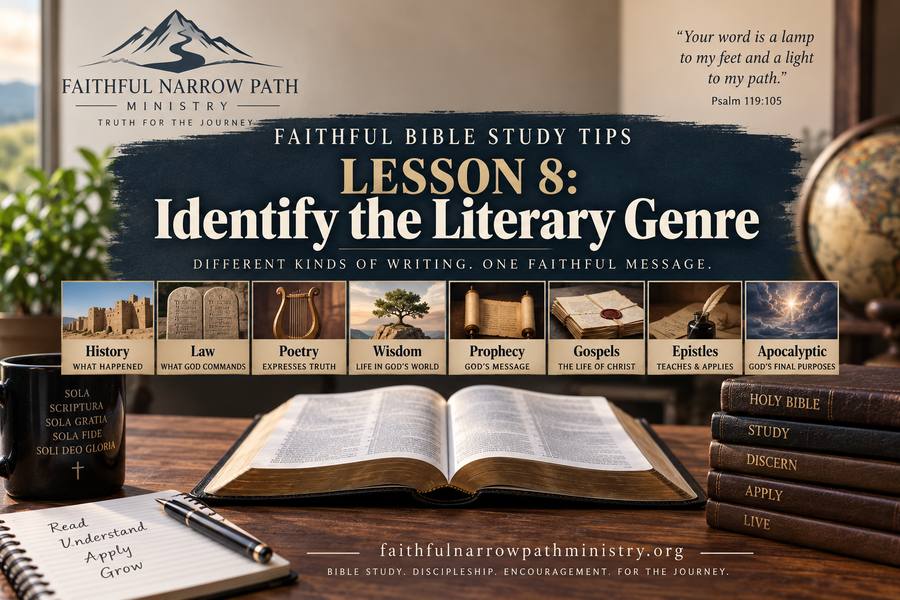
Faithful Bible Study Tips
Lesson 8: Identify the Literary Genre
Lesson 7 gave us a practical habit:
Read the passage, not just the verse.
Once we are reading the full passage, the next question is:
What kind of writing am I reading?
That matters because Scripture contains several kinds of literature.
History does not communicate exactly like poetry.
A proverb does not function exactly like a promise.
A letter is not read exactly like a vision.
The Bible is one unified Word of God, but God chose to communicate through different literary forms.
Faithful interpretation requires us to respect those forms.
What Is Literary Genre?
Literary genre simply means the type or form of writing we are reading.
The Bible contains several major kinds of literature, including:
- Historical narrative
- Law
- Poetry
- Wisdom literature
- Prophecy
- Gospels
- Epistles
- Apocalyptic literature
These categories help us recognize how a passage communicates.
Genre affects what kind of questions we should ask and how the author is presenting truth.
Why Genre Matters
We naturally read different kinds of writing differently in everyday life.
We do not read a legal contract the same way we read a poem.
We do not read a personal letter the same way we read a historical account.
The same principle applies to Scripture.
If we ignore genre, we may force a passage to communicate in a way it was never intended to communicate.
The goal is not to make Bible study complicated.
The goal is to read each passage according to the way God chose to give it.
Genre Does Not Change the Authority of Scripture
Different genres do not have different levels of authority.
A Psalm is no less inspired than Romans.
A proverb is no less Scripture than Genesis.
Revelation is no less authoritative because it uses symbolism.
Genre affects how we interpret the form of the text, not whether we submit to it as God’s Word.
That distinction is important.
Recognizing genre should never become an excuse for dismissing difficult teaching.
Historical Narrative
Historical narrative tells us what happened.
Books such as Genesis, Exodus, Joshua, Judges, Samuel, Kings, Acts, and large portions of the Gospels contain narrative.
Narrative often includes:
- People
- Events
- Conversations
- Conflict
- Decisions
- Consequences
- God’s actions in history
One important caution is that description is not automatically prescription.
Just because Scripture records that someone did something does not mean God is commanding us to imitate it.
The text may describe faithful obedience.
It may also describe sin, foolishness, failure, or judgment.
We will examine that distinction more directly in Lesson 13: Descriptive or Prescriptive?
For now, the key point is simple:
Narrative tells us what happened, but we still need to ask what the author intends us to understand through it.
Law
Biblical law includes commands given within God’s covenant dealings, especially with Israel.
When reading Old Testament law, we need to recognize its covenant setting.
A command given under the Mosaic covenant cannot simply be transferred directly into New Covenant practice without considering how it relates to the rest of Scripture and to Christ’s fulfillment.
That does not make Old Testament law irrelevant.
It means we read it according to its place in redemptive history.
Genre helps us recognize that legal material functions differently from narrative, poetry, or wisdom literature.
Poetry
Poetry often communicates through:
- Imagery
- Parallelism
- Metaphor
- Repetition
- Emotional expression
The Psalms are the clearest example.
Poetic language can be vivid.
A Psalm may describe mountains trembling, rivers clapping their hands, or God sheltering His people beneath His wings.
Those expressions communicate real truth, but they are not always intended as literal physical descriptions.
Recognizing poetry helps us appreciate the force of the language without flattening its imagery.
Wisdom Literature
Books such as Proverbs, Ecclesiastes, and Job contain wisdom literature.
Wisdom literature teaches us how to live wisely before God.
Proverbs especially often describes general patterns of life under God’s moral order.
That means a proverb should not automatically be treated as an unconditional promise.
A proverb may describe what ordinarily follows wisdom, diligence, foolishness, or laziness without claiming that no exceptions can ever occur in a fallen world.
Genre helps us recognize the difference between a wisdom principle and an absolute guarantee.
Prophecy
The prophets spoke God’s Word to real people in real covenant situations.
Prophetic books frequently include:
- Calls to repentance
- Warnings of judgment
- Covenant accusations
- Promises of restoration
- Messianic expectation
- Symbolic and poetic imagery
Prophecy is not merely prediction.
Much prophetic preaching addressed the spiritual condition of God’s people in the prophet’s own time.
At the same time, some prophecies clearly look forward to future fulfillment, including the coming Messiah and God’s final purposes.
Genre helps us respect both the immediate message and the larger redemptive significance.
The Gospels
The Gospels are historical accounts centered on the person and work of Jesus Christ.
They include narrative, teaching, parables, miracles, prophecy, dialogue, and Old Testament quotations.
That means a Gospel may contain several literary forms within one larger book.
A parable should be handled as a parable.
A historical event should be read as an event.
A direct command should be examined as teaching.
The Gospels do not merely provide information about Jesus.
They proclaim who He is and what He came to accomplish.
Epistles
The New Testament letters were written to real churches or individuals.
They often contain:
- Doctrine
- Correction
- Encouragement
- Commands
- Warnings
- Practical instruction
Epistles frequently develop arguments step by step.
That means their logical flow matters.
We have already encountered that principle in the literary-context lessons.
Here the new point is simply this:
Recognizing that we are reading a letter helps us expect sustained reasoning, instruction, and pastoral application.
Apocalyptic Literature
Apocalyptic literature uses vivid imagery, symbolism, visions, cosmic scenes, and dramatic contrasts.
Revelation is the clearest New Testament example, with apocalyptic features also appearing elsewhere in Scripture.
Because this genre uses symbolism heavily, we should be cautious about treating every image as a literal physical description.
At the same time, symbolism does not mean the message is vague or meaningless.
The images communicate real theological truth.
Good interpretation asks how the symbols function within the passage, the biblical book, and the rest of Scripture.
Genre tells us to expect symbolism without giving us permission to invent meanings.
Example: Proverbs 22:6
Proverbs 22:6 says:
“Train up a child in the way he should go; even when he is old he will not depart from it.”
If we treat Proverbs as a collection of unconditional promises, we may conclude that faithful parenting guarantees a particular outcome in every case.
But Proverbs is wisdom literature.
It normally communicates wise principles about life under God’s order.
The verse teaches a real principle about formation and instruction.
It should not be turned into a mechanical guarantee that eliminates human responsibility, sin, or the complexity of life in a fallen world.
Genre helps us hear the verse as wisdom.
Example: Psalm 91
Psalm 91 contains powerful language about God’s protection.
It speaks of refuge, shelter, danger, arrows, pestilence, and deliverance.
If every poetic statement were treated as an unconditional promise that no faithful believer will ever suffer physical harm, we would quickly run into conflict with the rest of Scripture.
The Psalm expresses confidence in God’s sovereign protection and faithfulness through poetic language.
Genre helps us receive the truth without forcing the poetry into wooden literalism.
Genre Helps Prevent Category Mistakes
A category mistake happens when we interpret one kind of literature as though it were another.
For example:
- Treating poetry as straightforward prose description
- Treating a proverb as an unconditional promise
- Treating every narrative event as a command
- Treating apocalyptic symbolism as though every image must be woodenly literal
- Treating prophetic imagery exactly like an epistle
These mistakes can produce confident interpretations that the text itself does not require.
Recognizing genre gives us an important interpretive boundary.
Genre and Literal Interpretation
Sometimes people hear discussion of genre and assume it means we are no longer reading Scripture literally.
That is not what responsible interpretation means.
Faithful interpretation seeks the meaning intended by the author, which includes recognizing metaphor, imagery, poetry, and symbolism when the text uses them.
If Jesus says:
“I am the door,”
faithful interpretation does not require believing that Jesus has hinges.
The metaphor communicates that He is the true way of access to salvation.
Recognizing figures of speech is not a departure from faithful interpretation.
It is part of it.
Do Not Use Genre to Avoid Clear Teaching
Genre can be misused.
A reader may label uncomfortable language as:
poetic
symbolic
or
figurative
simply because the teaching is difficult.
That is not responsible interpretation.
Genre must be identified from the actual features of the text.
We do not choose a genre because it gives us the interpretation we prefer.
We recognize the literary form the author actually used and interpret accordingly.
One Passage Can Contain More Than One Literary Feature
Biblical books do not always fit neatly into one simple category.
A historical book may contain poetry.
A prophet may include narrative.
A Gospel may contain parables.
An epistle may quote poetic or hymnic material.
Revelation contains letters, visions, prophecy, and symbolism.
So sometimes the better question is not only:
What kind of book is this?
but also:
What kind of writing is this particular section?
That keeps us from making overly broad assumptions.
A Simple Genre Check
Before interpreting a passage, ask:
What kind of writing is this?
Then ask:
How does this kind of writing normally communicate?
For narrative:
What happened, and what does the author want us to understand through it?
For poetry:
What imagery or parallelism is being used?
For wisdom:
Is this a general principle or an absolute promise?
For an epistle:
What argument or instruction is being developed?
For prophecy or apocalyptic literature:
How are historical setting, imagery, and larger biblical themes shaping the message?
Genre Is a Starting Point, Not the Final Interpretation
Simply identifying a passage as poetry, prophecy, narrative, or wisdom does not settle its meaning.
Genre tells us how to approach the passage.
It does not do the interpretive work for us.
We still need to read carefully.
And that leads naturally to the next step in our study process.
Core Principle
Identify the kind of literature you are reading before deciding how the passage should be interpreted.
God communicated through history, law, poetry, wisdom, prophecy, letters, visions, and other literary forms.
Faithful readers respect the form in which the message was given.
Closing Reminder
Lesson 7 taught us to read the passage rather than isolating a verse.
Lesson 8 adds the next question:
What kind of passage am I reading?
This is not a repeat of literary context.
It is the next interpretive step.
First, read the complete thought.
Then identify the kind of literature you are reading.
Once we know what kind of text is before us, we are better prepared to slow down and notice what the author actually says.
Up Next
Lesson 9: Observe Before You Interpret
Once we have read the passage and identified its literary genre, we are ready to slow down and observe.
Lesson 9 will focus on seeing what is actually in the text before deciding what it means.
We will look at repeated words, contrasts, commands, questions, structure, relationships, and other details that help us move from careful reading toward faithful interpretation.
✝️ Soli Deo Gloria – To God Alone Be the Glory

Leave a comment