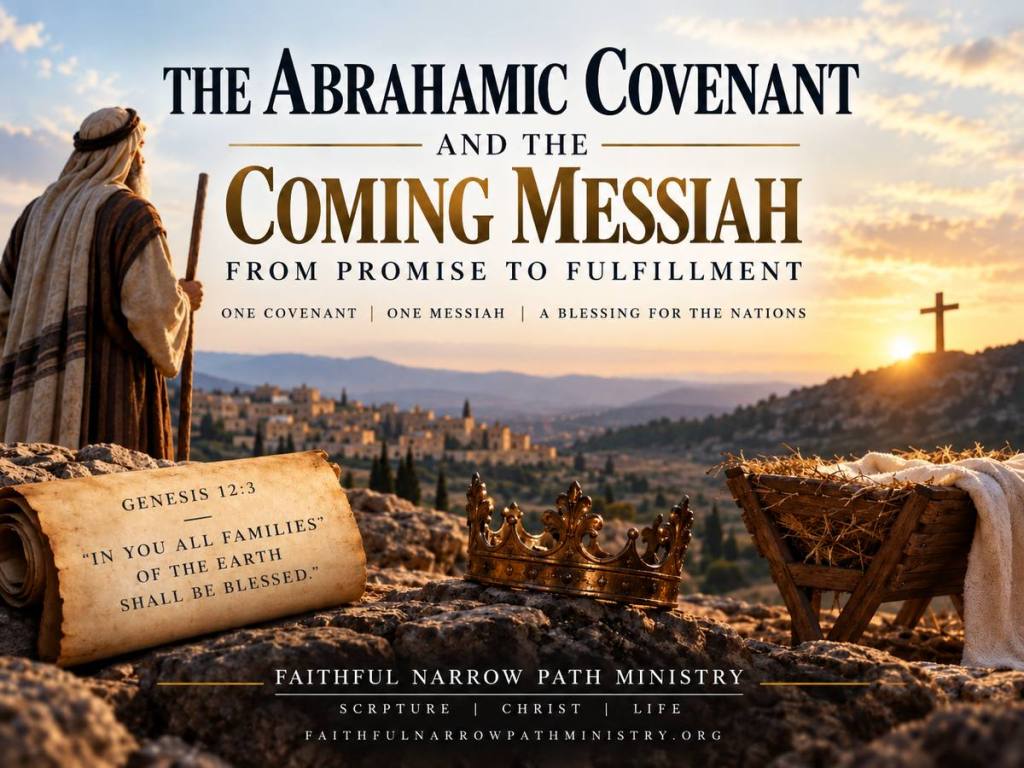
Study Type: Topical Biblical Theology
This study is intentionally different from our usual passage focused expository Bible studies. Rather than working verse by verse through one primary passage, we are tracing one redemptive question across Scripture:
How does the covenant God made with Abraham move toward and find its fulfillment in the coming Messiah?
The Abrahamic Covenant included real historical promises concerning descendants, land, nationhood, kings, and blessing.
But those promises were also carrying forward something much greater.
God promised that through Abraham blessing would reach all the families of the earth.
As the biblical story unfolds, that promise becomes increasingly focused until the New Testament identifies Jesus Christ as the climactic promised offspring through whom the saving blessing reaches the nations.
Key Passages
Genesis 12:1 to 3
Genesis 15:1 to 21
Genesis 17:1 to 8
Genesis 22:15 to 18
Genesis 49:8 to 10
2 Samuel 7:12 to 16
Matthew 1:1
Luke 1:68 to 75
Romans 4:1 to 17
Galatians 3:6 to 9
Galatians 3:16
Galatians 3:26 to 29
Hebrews 11:8 to 16
We encourage you to follow along in your Bible as you work through this study. Key verses are quoted throughout, while the broader passages should be read in their full context.
The Promise Begins With Abraham
The story begins in Genesis 12.
God calls Abram to leave his country and go to a land that God will show him.
Then God gives a remarkable series of promises.
He will make Abram into a great nation.
He will bless him.
He will make his name great.
And the promise reaches beyond Abram himself when God says:
“in you all the families of the earth shall be blessed.”
Genesis 12:3 (ESV)
That statement immediately expands the horizon.
God’s purpose is not limited to one man.
It is not limited even to the nation that will eventually descend from him.
The nations are already in view.
At this point Genesis does not yet tell us precisely how that worldwide blessing will come.
The remainder of Scripture gradually answers that question.
God Establishes His Covenant
Genesis 15 deepens the promise.
Abram faces an obvious problem.
God has promised descendants, yet Abram remains childless.
God takes him outside and tells him to look toward the heavens.
“So shall your offspring be.”
Genesis 15:5 (ESV)
Then Scripture gives us one of its foundational statements concerning faith:
“And he believed the LORD, and he counted it to him as righteousness.”
Genesis 15:6 (ESV)
Faith is not a minor feature of the Abrahamic Covenant.
It is central to the biblical account.
Abraham does not earn the promise through righteous performance.
He believes the God who has promised.
Paul will later return directly to this verse when explaining justification by faith in Romans 4 and Galatians 3.
Genesis 15 then records the covenant ceremony.
Animals are divided and a path is formed between the pieces.
In the ancient covenant setting, passing between divided animals communicated the seriousness of covenant commitment.
But something remarkable happens.
God alone symbolically passes between the pieces.
A smoking fire pot and flaming torch represent His presence.
Abraham does not walk the path alongside Him.
This strongly emphasizes that the ultimate fulfillment of the covenant rests upon God’s faithfulness to His own promise.
Abraham will be called to faith and obedience.
His actions matter.
But Abraham is not carrying the redemptive plan forward through the strength of his own faithfulness.
God binds Himself to His promise.
Abraham’s Faith Was Real but Not Perfect
The biblical account does not idealize Abraham.
He trusts God, but his trust is not always expressed perfectly.
Genesis 16 provides a clear example.
Abraham and Sarah had received God’s promise, yet as the years passed they attempted to secure descendants through Hagar.
Ishmael was born.
But God’s covenant purpose would not proceed through human attempts to manufacture the fulfillment of His promise.
The promised line would come through Isaac.
That distinction is important.
Biblical faith does not mean that Abraham never struggled, never feared, or never made poor decisions.
The focus of the covenant story is not the perfection of Abraham.
It is the faithfulness of Abraham’s God.
The Covenant Promise Becomes More Specific
Genesis 17 develops the covenant further.
God declares:
“I have made you the father of a multitude of nations.”
Genesis 17:5 (ESV)
Kings will come from Abraham.
Descendants will multiply.
The land promise is reaffirmed.
Circumcision is given as the covenant sign.
But God also identifies the line through which the covenant promise will continue.
Isaac.
Abraham has other descendants, but the covenant line moves through Isaac.
Isaac has two sons, but the promise continues through Jacob.
Jacob has twelve sons, but the royal expectation becomes particularly associated with Judah.
The promise is narrowing.
Not because God is abandoning the nations.
Quite the opposite.
God is narrowing the line through which blessing will ultimately reach them.
The Promised Offspring
Genesis 22 brings Abraham’s faith into one of its greatest tests.
God commands Abraham to offer Isaac.
This creates an enormous tension.
Isaac is not merely Abraham’s beloved son.
He is the son through whom God said the covenant promise would continue.
Hebrews later explains that Abraham trusted that God was able even to raise the dead.
Abraham did not understand how everything would work out.
But he had learned that God’s promise could be trusted.
God ultimately provides a substitute, and Isaac is spared.
Afterward the covenant promise is repeated:
“in your offspring shall all the nations of the earth be blessed.”
Genesis 22:18 (ESV)
Once again, the nations are in view.
And once again, Abraham’s offspring stands at the center of the promise.
That word will become extremely important when Paul later explains the covenant in Galatians.
From Abraham to Judah
The covenant line continues through Isaac and Jacob.
Near the end of Genesis, Jacob blesses his sons.
When he comes to Judah, the promise takes on unmistakably royal language:
“The scepter shall not depart from Judah.”
Genesis 49:10 (ESV)
Now the biblical storyline contains another important development.
The promised line is associated with kingship.
Abraham.
Isaac.
Jacob.
Judah.
The promised blessing to the nations is gradually becoming connected with a coming royal figure.
From Judah to David
Centuries later, the royal promise becomes more focused through David.
God tells David that one of his descendants will come after him and that his kingdom will be established.
God promises:
“I will establish the throne of his kingdom forever.”
2 Samuel 7:13 (ESV)
There is an immediate historical fulfillment through Solomon and the Davidic dynasty.
But the promise ultimately reaches beyond any ordinary king.
No merely human descendant of David established an everlasting kingdom.
The expectation therefore looks forward.
The Abrahamic promise and the Davidic promise are not competing covenant stories.
They belong to the same unfolding redemptive purpose.
The promised offspring through whom blessing would reach the nations is increasingly revealed as a royal Messiah.
Matthew Connects Jesus to Abraham and David
The New Testament opens with an unmistakable announcement:
“The book of the genealogy of Jesus Christ, the son of David, the son of Abraham.”
Matthew 1:1 (ESV)
Matthew could hardly make the covenant connection clearer.
Jesus is introduced as:
Son of Abraham.
Son of David.
He stands in the line of the promise to Abraham.
He stands in the royal line of David.
The arrival of Jesus is therefore not the beginning of an unrelated plan.
His coming belongs to the fulfillment of promises God had been carrying forward for centuries.
God Remembered His Covenant Promise
Luke makes the same connection.
When Zechariah praises God in Luke 1, he celebrates the salvation God is bringing through the house of David.
Then he connects that salvation with:
“the oath that he swore to our father Abraham.”
Luke 1:73 (ESV)
God had not forgotten Abraham.
He had not forgotten David.
The long period of waiting did not mean the promise had failed.
God was faithfully moving redemptive history toward Christ.
The Gospel Was Announced Beforehand to Abraham
Paul makes the connection explicit in Galatians 3.
First, he returns to Genesis 15:
“Abraham believed God, and it was counted to him as righteousness.”
Galatians 3:6 (ESV)
Then Paul says that Scripture:
“preached the gospel beforehand to Abraham.”
Galatians 3:8 (ESV)
And what promise does Paul identify?
The promise that:
“In you shall all the nations be blessed.”
Galatians 3:8 (ESV)
Paul sees Genesis 12 as containing an early announcement of the gospel’s worldwide reach.
This does not mean Abraham understood the entire gospel with the clarity available after Christ’s death and resurrection.
Redemptive revelation unfolded progressively.
But the promise itself was already moving toward the gospel.
Through Abraham’s line would come the One through whom salvation would reach the nations.
The Promised Offspring Reaches Its Climax in Christ
Paul then makes one of the strongest messianic connections in the New Testament.
Galatians 3:16 says:
“Now the promises were made to Abraham and to his offspring.”
Paul then identifies the climactic offspring as:
“Christ.”
We should understand this carefully.
Paul is not denying that the word offspring can refer collectively to Abraham’s many descendants.
Abraham truly had physical descendants.
Israel truly descended from Abraham.
The covenant genuinely produced a historical people.
But Paul identifies Christ as the climactic and representative offspring in whom the covenant promise reaches its redemptive fulfillment.
The many descendants mattered.
Israel mattered.
The covenant history mattered.
But the line was ultimately moving toward one particular descendant.
Jesus Christ.
Abraham, Faith, and Justification
Romans 4 helps us understand why Abraham becomes so important to Paul’s explanation of salvation.
Paul again returns to Genesis 15:6.
Abraham believed God, and righteousness was counted to him.
Importantly, this happened before Abraham received the sign of circumcision.
Paul therefore shows that Abraham is not merely the physical ancestor of Israel.
He is also:
“the father of all who believe.”
Romans 4:11 (ESV)
The saving blessing connected with Abraham cannot be reduced to ethnicity.
It is received through faith.
This fits the covenant story from the beginning.
God promised.
Abraham believed.
God counted him righteous.
The pattern does not teach that faith itself becomes a meritorious work.
Abraham’s faith rests upon God and His promise.
Likewise, Christian faith does not save because believing is an impressive human accomplishment.
Faith receives Christ.
The ground of our salvation is not the strength of our faith.
It is Christ and His righteousness.
The Land Promise and the Greater Inheritance
The land promised to Abraham was real.
We should not spiritualize the covenant so completely that its historical promises disappear.
Abraham really was promised land.
His descendants really did inherit Canaan.
Israel really became a nation in a real geographical place.
But the New Testament also broadens our understanding of the inheritance.
Romans 4:13 speaks of Abraham receiving the promise that he would be:
“heir of the world.”
Hebrews 11 tells us that Abraham lived in the promised land as a stranger and looked beyond it toward:
“the city that has foundations, whose designer and builder is God.”
Hebrews 11:10 (ESV)
Later in the chapter, Abraham and the other faithful are described as desiring:
“a better country, that is, a heavenly one.”
Hebrews 11:16 (ESV)
The land promise was therefore real historically, while also participating in a larger movement toward the final inheritance God gives His people.
Canaan mattered.
But Canaan was not the endpoint of redemption.
The biblical horizon ultimately extends toward the kingdom of God and the renewed creation secured through Christ.
Abraham Had to Wait
One of the clearest lessons running through Abraham’s story is the relationship between faith and waiting.
God promised.
Then Abraham waited.
A son was promised.
He waited.
A nation was promised.
Abraham never lived to see Israel established as a nation.
Kings were promised.
He never saw David.
Blessing to the nations was promised.
He never saw the incarnation of Christ.
Much of the covenant’s fulfillment extended far beyond Abraham’s lifetime.
That did not mean God had forgotten His promise.
It meant Abraham had to trust the faithfulness of God beyond what he could personally see.
The same pattern continues throughout redemptive history.
Israel waited.
The prophets waited.
Generation after generation waited.
Then:
“when the fullness of time had come, God sent forth his Son.”
Galatians 4:4 (ESV)
God’s timing was not late.
The promise was moving according to His purpose.
One Redemptive People Centered in Christ
Those who belong to Christ now share in the saving blessing promised through Abraham.
Paul writes:
“if you are Christ’s, then you are Abraham’s offspring, heirs according to promise.”
Galatians 3:29 (ESV)
Christians do not become physical descendants of Abraham.
Nor should we simply say that the church becomes ethnic Israel.
The biblical relationship is more careful than that.
From a Reformed covenantal perspective, Scripture reveals one unfolding people of God across redemptive history, while the covenant administration changes decisively with the coming of Christ.
God is not pursuing two unrelated plans of salvation.
The Old Testament covenant people were moving toward Christ.
The earliest New Covenant church consisted of Jewish believers in Israel’s Messiah.
Then Gentiles were brought into the saving blessings through that same Messiah.
Paul describes Gentile believers elsewhere as being grafted into the olive tree rather than being given a separate redemptive tree.
Jew and Gentile are saved through the same Christ.
The dividing wall is broken down.
The people of God are now gathered around the Messiah in whom the covenant promises reach their fulfillment.
Those Who Belong to Christ Are Heirs
Paul brings the argument together in Galatians 3:
“for in Christ Jesus you are all sons of God, through faith.”
Galatians 3:26 (ESV)
Then:
“if you are Christ’s, then you are Abraham’s offspring, heirs according to promise.”
Galatians 3:29 (ESV)
This is one of the great conclusions of the Abrahamic Covenant storyline.
God promised that blessing would reach the nations through Abraham.
Christ came through Abraham’s line.
The gospel went outward to the nations.
And everyone united to Christ through faith shares in the saving inheritance secured through Him.
What began with one man in Genesis 12 reaches outward across the world through Jesus Christ.
From Promise to Fulfillment
The movement of Scripture is remarkably consistent.
God calls Abraham.
God promises descendants.
God promises land.
God promises kings.
God promises blessing to the nations.
The covenant line moves through Isaac.
Then Jacob.
Then Judah.
The royal line moves through David.
The prophets continue looking forward.
Then Jesus comes.
Matthew calls Him:
Son of Abraham.
Son of David.
Paul identifies Him as the climactic promised:
Offspring.
The gospel goes to the nations.
And those who belong to Christ become heirs according to promise.
These are not disconnected biblical stories.
They are parts of one unfolding redemptive plan.
Core Truth
The Abrahamic Covenant contained real historical promises, but its redemptive trajectory ultimately centered upon Jesus Christ.
God promised Abraham descendants, land, nationhood, kings, and blessing.
Through Abraham’s offspring, blessing would reach the nations.
That promise moved through Isaac, Jacob, Judah, and David until it reached its climactic fulfillment in Christ.
Jesus is the promised Messiah through whom the saving blessing of Abraham reaches Jew and Gentile alike.
And those who belong to Christ through faith become heirs according to promise.
What Abraham Teaches Us About Faith
Abraham’s story teaches us that faith often requires trusting God before we can see how His purposes will unfold.
Abraham knew the promise.
He did not know every step.
He experienced delay.
He struggled.
He made mistakes.
Yet God remained faithful.
That matters for Christians.
Faith does not mean we understand everything God is doing.
It means we trust the God who has revealed Himself even when His providence remains difficult to understand.
The strength of our hope does not rest upon our ability to see the entire plan.
It rests upon the character of the One who made the promise.
Application
The Abrahamic Covenant should strengthen our confidence in the faithfulness of God.
Centuries passed between Abraham and Christ.
Israel experienced slavery.
Deliverance.
Kingdom.
Division.
Exile.
Restoration.
Humanly speaking, there were many moments when someone could have wondered how the promise would ever reach its fulfillment.
But God never lost control of the story.
That should affect how we understand waiting.
God’s timing may extend far beyond what we expected.
His providence may include circumstances we would never choose.
We may not understand how individual pieces fit together while we are living through them.
But the coming of Christ proves something essential:
God does not forget what He promises.
We should also examine where our confidence rests.
Abraham was not justified because he performed well enough to deserve the covenant blessing.
He believed God.
Christian faith likewise does not rest on our performance.
Our hope rests upon Christ and His completed work.
Challenge and Reflection
Consider the Abrahamic Covenant and ask:
Do I trust God only when I can understand how His purposes will unfold?
Have I ever confused waiting with God’s absence?
Am I trying to accomplish through my own strength what ultimately depends upon God?
Does my confidence before God rest upon my performance or upon Christ?
Do I read the Old Testament as a collection of disconnected stories, or do I recognize the redemptive line that leads toward Jesus?
Do I recognize that the gospel reaching the nations is part of a promise God began unfolding thousands of years ago?
Abraham saw much of the promise from a distance.
We look back through the cross and resurrection and see far more clearly where the promise was leading.
The promised offspring has come.
The blessing promised to the nations is ultimately secured and mediated through Him.
At the center of that promised blessing stands Jesus Christ.
Closing Charge
The Abrahamic Covenant reaches across the biblical story.
God called one man.
He promised descendants.
He promised land.
He promised a nation.
He promised kings.
And He promised that through Abraham blessing would reach all the families of the earth.
Generation after generation passed.
The line narrowed.
Isaac.
Jacob.
Judah.
David.
Then Christ came.
The promised blessing to the nations was not ultimately found in Abraham’s wealth, Israel’s political strength, or the glory of an earthly kingdom.
It reaches its fulfillment in the Messiah who came through Abraham’s line.
Jesus Christ.
Through Him sinners are justified through faith.
Through Him Jew and Gentile are gathered into one redeemed people.
Through Him the blessing promised to Abraham reaches the nations.
And in Him those who believe become heirs according to promise.
Abraham trusted God before he could see the full fulfillment.
We have the privilege of looking backward and seeing that God kept His Word.
And because He kept His covenant promise across centuries of redemptive history, we have every reason to trust the God whose promises still await their final completion.
The God who promised is faithful.
The promised offspring has come.
Jesus Christ stands at the center of the blessing promised to the nations.
Soli Deo Gloria
To God alone be the glory.
Scriptures Referenced
Primary and Key Passages: Genesis 12:1 to 3, Genesis 15:1 to 21, Genesis 17:1 to 8, Genesis 22:15 to 18, Genesis 49:8 to 10, 2 Samuel 7:12 to 16, Matthew 1:1, Luke 1:68 to 75, Romans 4:1 to 17, Galatians 3:6 to 9, Galatians 3:16, Galatians 3:26 to 29, Hebrews 11:8 to 16
Additional References: Genesis 16, Genesis 21:12, Genesis 26:1 to 5, Genesis 28:10 to 15, Romans 4:13, Romans 11:17 to 24, Galatians 4:4, Ephesians 2:11 to 22, Hebrews 11:17 to 19

Leave a comment