
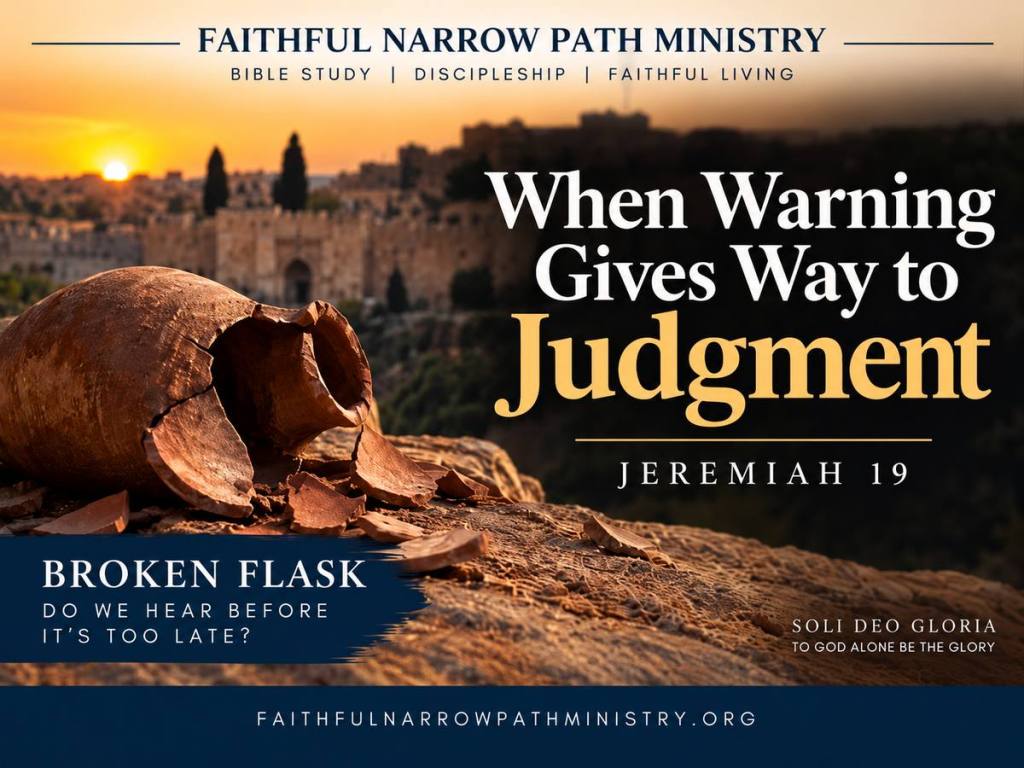
When Warning Gives Way to Judgment
Jeremiah 19
Study Type: Expository Bible Study
Scripture Reading
Jeremiah 19 (ESV)
The Broken Flask
[1] Thus says the LORD, “Go, buy a potter’s earthenware flask, and take some of the elders of the people and some of the elders of the priests, [2] and go out to the Valley of the Son of Hinnom at the entry of the Potsherd Gate, and proclaim there the words that I tell you. [3] You shall say, ‘Hear the word of the LORD, O kings of Judah and inhabitants of Jerusalem. Thus says the LORD of hosts, the God of Israel: Behold, I am bringing such disaster upon this place that the ears of everyone who hears of it will tingle. [4] Because the people have forsaken me and have profaned this place by making offerings in it to other gods whom neither they nor their fathers nor the kings of Judah have known; and because they have filled this place with the blood of innocents, [5] and have built the high places of Baal to burn their sons in the fire as burnt offerings to Baal, which I did not command or decree, nor did it come into my mind—[6] therefore, behold, days are coming, declares the LORD, when this place shall no more be called Topheth, or the Valley of the Son of Hinnom, but the Valley of Slaughter. [7] And in this place I will make void the plans of Judah and Jerusalem, and will cause their people to fall by the sword before their enemies, and by the hand of those who seek their life. I will give their dead bodies for food to the birds of the air and to the beasts of the earth. [8] And I will make this city a horror, a thing to be hissed at. Everyone who passes by it will be horrified and will hiss because of all its wounds. [9] And I will make them eat the flesh of their sons and their daughters, and everyone shall eat the flesh of his neighbor in the siege and in the distress, with which their enemies and those who seek their life afflict them.’
[10] “Then you shall break the flask in the sight of the men who go with you, [11] and shall say to them, ‘Thus says the LORD of hosts: So will I break this people and this city, as one breaks a potter’s vessel, so that it can never be mended. Men shall bury in Topheth because there will be no place else to bury. [12] Thus will I do to this place, declares the LORD, and to its inhabitants, making this city like Topheth. [13] The houses of Jerusalem and the houses of the kings of Judah—all the houses on whose roofs offerings have been offered to all the host of heaven, and drink offerings have been poured out to other gods—shall be defiled like the place of Topheth.’”
[14] Then Jeremiah came from Topheth, where the LORD had sent him to prophesy, and he stood in the court of the LORD’s house and said to all the people: [15] “Thus says the LORD of hosts, the God of Israel, behold, I am bringing upon this city and upon all its towns all the disaster that I have pronounced against it, because they have stiffened their neck, refusing to hear my words.”
Historical Background
Jeremiah ministered during the final decades of Judah before Jerusalem fell to Babylon.
By Jeremiah 19, Judah’s rebellion was not a temporary lapse. The people had repeatedly turned to idolatry, ignored prophetic warnings, trusted false religion, and practiced things God had explicitly condemned.
Jeremiah had spent years calling them to repentance.
The problem was not that Judah lacked warning.
The problem was that they refused to listen.
God tells Jeremiah to take an earthenware flask, gather some of the elders of the people and priests, and go to the Valley of the Son of Hinnom near the Potsherd Gate.
There Jeremiah is to announce judgment.
Then he is to break the flask.
The action becomes a visible sermon.
Judah had resisted God so persistently that judgment was no longer being announced only in words. God was giving them a picture of what their rebellion would bring.
Literary Context
Jeremiah 18 and Jeremiah 19 belong together.
In Jeremiah 18, Jeremiah watches a potter reshape spoiled clay into another vessel. God uses the image to teach His sovereign authority over nations and the real call to repentance.
If a nation turns from evil, God may relent from announced judgment.
Jeremiah 19 intensifies the picture.
Jeremiah is no longer watching wet clay that can be reshaped.
He carries a finished earthenware flask.
Then God tells him to break it.
The movement is deliberate.
Jeremiah 18 emphasizes the call to turn.
Jeremiah 19 shows the seriousness of repeatedly refusing to do so.
Jeremiah 19:1 to 3
God Sends Jeremiah With Witnesses
God tells Jeremiah to buy an earthenware flask and take with him some of the elders of the people and some of the elders of the priests.
Representatives of both civic and religious leadership are present.
This is not a private warning.
God is publicly confronting Judah through His prophet.
Jeremiah is sent to the Valley of the Son of Hinnom, a place already associated with idolatrous worship and child sacrifice connected with Topheth.
There he is commanded to proclaim:
“Hear the word of the LORD”
That opening command is important.
Hear.
One of the final accusations of the chapter will be that Judah had refused to do exactly that.
God had spoken.
The question was whether His people would listen.
Jeremiah 19:4 to 5
God Identifies the Sin
God does not leave Judah guessing about why judgment is coming.
He names their rebellion.
They had forsaken Him.
They had profaned the place.
They had made offerings to other gods.
They had filled the place with innocent blood.
They had built high places to Baal.
They had burned their sons as offerings.
The judgment of Jeremiah 19 is therefore not random anger.
It is judicial judgment against persistent covenant rebellion.
The reference to child sacrifice shows how far Judah’s corruption had progressed.
God says these practices were things:
“which I did not command or decree, nor did it come into my mind.”
This does not mean God was surprised by what happened.
It emphasizes how completely foreign and abhorrent these acts were to His revealed will.
Judah had become so corrupted by idolatry that things utterly contrary to God were being practiced among a people who claimed His name.
Idolatry Never Stays Isolated
Jeremiah 19 shows that false worship does not remain confined to worship.
Judah’s idolatry eventually affected how people treated human life.
Once worship became corrupted, moral corruption followed.
What we believe about God shapes how we understand ourselves, other people, truth, justice, sexuality, authority, and human worth.
That is why idolatry is never merely an abstract theological error.
When something other than God receives the worship, allegiance, or authority that belongs to Him, disorder spreads into other areas of life.
In Judah, the consequences became horrifyingly visible.
Jeremiah 19:6 to 9
The Valley of Slaughter
Because of Judah’s rebellion, God declares that the place would no longer be called Topheth or the Valley of the Son of Hinnom.
It would become:
“the Valley of Slaughter.”
The location associated with rebellion would become associated with judgment.
God announces that He will frustrate the plans of Judah and Jerusalem and allow the people to fall before their enemies.
Jerusalem would become an object of horror.
The coming siege would become so severe that hunger and desperation would produce unimaginable conditions.
These verses are intentionally disturbing.
We should not try to make them comfortable.
Jeremiah is describing severe covenant judgment as Babylonian destruction approaches.
The severity of the judgment reflects the seriousness of the rebellion Judah continued to defend.
The Patience and Judgment of God
Jeremiah 19 forces us to hold together two biblical truths.
God is patient.
And God judges sin.
He warns.
He calls sinners to repentance.
He shows mercy.
But His patience must never be confused with indifference.
Judah had received repeated warnings through God’s prophets.
Their rebellion continued anyway.
God’s patience is real, and God’s judgment is real.
One does not cancel the other.
Jeremiah 19:10 to 11
The Broken Flask
Now comes the central action of the chapter.
Jeremiah breaks the flask in front of the men who accompanied him and declares that God will break the people and the city as one breaks a potter’s vessel that cannot simply be mended.
The contrast with Jeremiah 18 is striking.
Wet clay can be reshaped.
A fired vessel smashed into pieces cannot be restored to its former condition.
The coming judgment was certain.
Jerusalem would fall.
The city would be devastated.
The temple would eventually be destroyed.
Many would die or be carried into exile.
But an important theological guardrail is necessary.
The broken flask does not mean that God’s entire redemptive purpose for His people had failed or that He would never show them mercy again.
Jeremiah himself will later announce restoration and the New Covenant.
The broken flask represents the certainty and severity of the historical judgment God was bringing upon Judah and Jerusalem.
God’s larger redemptive purpose would continue.
Warning Is an Expression of Mercy
There is something easy to miss in this chapter.
God warned Judah before judgment came.
Again and again.
Jeremiah’s ministry itself demonstrates divine patience.
God exposed sin.
He commanded repentance.
He warned of consequences.
He gave the people opportunity to hear Him.
That means biblical warning should not be understood as the opposite of mercy.
The warning itself can be an expression of mercy.
Paul later writes that God’s kindness is meant to lead sinners to repentance in Romans 2:4.
The proper response to divine patience is not:
God has not judged me, so my sin must not matter.
It is:
God has been patient with me, so I should repent.
Jeremiah 19:12 to 13
Corruption Had Spread Through Jerusalem
God says He will make Jerusalem like Topheth.
The houses of Jerusalem and even the houses of Judah’s kings had been defiled.
Offerings had been made on rooftops to the host of heaven, and drink offerings had been poured out to other gods.
Idolatry was no longer confined to one notorious location.
It had spread through the life of the city.
The rebellion had become deeply embedded in Judah’s spiritual and cultural life.
Jeremiah 19:14 to 15
They Refused to Hear
After delivering the message at Topheth, Jeremiah returns to the temple.
There he stands in the court of the Lord’s house and speaks to the people.
The chapter closes with the spiritual diagnosis behind the judgment:
“they have stiffened their neck, refusing to hear my words.”
That statement gets to the heart of the chapter.
They refused to hear.
The image of a stiffened neck describes stubborn resistance.
God had spoken.
They would not turn.
They would not yield.
They would not repent.
Their problem was not lack of revelation.
It was resistance to revelation.
The Danger of Hearing Without Responding
Jeremiah 19 raises an uncomfortable question.
What happens when someone repeatedly hears the truth of God but continually refuses to respond to it?
Judah possessed tremendous spiritual privilege.
They had God’s revealed Word.
They had the temple.
They had priests.
They had prophets.
They knew the history of God’s covenant faithfulness.
Yet religious privilege did not excuse rebellion.
Religious familiarity is not the same thing as faithfulness.
A person can hear sermons.
Read Scripture.
Know theology.
Attend church.
Understand Christian doctrine.
And still resist what God has clearly revealed.
Hebrews later warns:
“Today, if you hear his voice, do not harden your hearts.”
Hebrews 3:15 (ESV)
Hearing God’s Word should lead toward faith, repentance, and obedience.
We should never become comfortable merely knowing what Scripture says while continually refusing to submit to it.
Historical Judgment and Christian Application
We need to apply Jeremiah 19 carefully.
This chapter records a specific covenant judgment against Judah and Jerusalem.
We are not Old Covenant Judah.
The church has not been given Israel’s exact covenant arrangement, land promises, temple structure, or covenant curses.
So we should not interpret every hardship in a Christian’s life as though God were reenacting Jeremiah 19 against that individual.
That would misuse the passage.
But the underlying truths remain.
God is holy.
Idolatry is serious.
Human beings are accountable to their Creator.
God’s Word must be heard.
Repeated rejection of truth is dangerous.
Divine patience should lead to repentance rather than presumption.
And final judgment remains a genuine biblical reality.
The Valley of Hinnom and Gehenna
The Valley of the Son of Hinnom becomes important later in biblical history.
Because of the horrific practices associated with the valley, its defilement, and its connection with judgment, it became a powerful image of divine judgment.
The Greek term Gehenna, used in the New Testament, is derived from the name of the Valley of Hinnom.
Jesus uses Gehenna when speaking seriously about final judgment.
Jeremiah 19 itself does not provide a complete doctrine of hell.
But the chapter helps explain why this location later carried such powerful associations.
A place marked by idolatry and innocent blood became a place marked by judgment.
Judgment Is Not the End of Jeremiah’s Message
Jeremiah 19 is severe.
But judgment is not the only message Jeremiah proclaims.
The same prophet who announces the breaking of the flask later announces one of Scripture’s greatest promises.
God says:
“I will make a new covenant.”
Jeremiah 31:31 (ESV)
And:
“I will forgive their iniquity, and I will remember their sin no more.”
Jeremiah 31:34 (ESV)
That contrast matters.
The God who judges sin is also the God who provides forgiveness.
Forgiveness does not come because God decides sin was never serious.
His redemptive plan moves toward Christ.
From Jeremiah to Christ
Jeremiah 19 makes the seriousness of sin difficult to ignore.
The gospel makes the greatness of God’s mercy equally difficult to ignore.
God does not solve the problem of judgment by pretending sin does not matter.
At the cross, Christ bears the judgment due to His people.
The sinless Son of God stands in the place of sinners.
Those united to Christ through faith receive forgiveness and reconciliation with God.
Paul writes:
“There is therefore now no condemnation for those who are in Christ Jesus.”
Romans 8:1 (ESV)
That promise becomes even more precious when we understand that condemnation is real.
Jeremiah 19 helps us feel the seriousness of judgment.
The gospel shows us the greatness of the refuge found in Christ.
Core Truth
God’s judgment on Judah was neither sudden nor arbitrary. It came after persistent idolatry, bloodshed, covenant rebellion, and repeated refusal to listen to His Word.
The broken flask became a visible picture of the judgment Judah’s rebellion had brought upon them.
But the chapter also reveals God’s patience.
He had warned them.
Again and again.
The tragedy was not that God refused to speak.
They refused to hear.
Application
Jeremiah 19 should cause us to examine how we respond when God’s Word confronts us.
The question is not merely:
Have I heard what Scripture says?
The deeper question is:
Am I willing to submit to what Scripture says?
When God exposes sin, do we repent or rationalize it?
When Scripture challenges an idol, do we surrender it or defend it?
When biblical truth conflicts with something we deeply want, which one receives the final word?
We should also take seriously the danger of spiritual hardening.
Repeatedly resisting conviction does not make truth disappear.
It can make us increasingly unwilling to hear it.
The proper response to biblical warning is not hopelessness.
It is repentance.
Repentance and the Christian Life
Repentance is not something Christians leave behind after conversion.
Believers continue examining their lives in light of God’s Word.
We continue confessing sin.
We continue turning from patterns that dishonor God.
We continue asking where pride, idolatry, or stubbornness may be taking root.
We do not do this because we must repeatedly earn our justification.
Our standing before God rests upon Christ.
But sanctification involves continuing repentance and growing obedience.
Grace does not teach us to become comfortable with sin.
It teaches us to turn from it and increasingly walk in holiness.
Challenge and Reflection
Consider these questions carefully:
Is there something God’s Word has repeatedly confronted in my life that I continue refusing to address?
Have I mistaken God’s patience for His approval?
Is anything receiving the worship, loyalty, trust, or devotion that belongs to God alone?
Do I welcome Scripture only when it agrees with me?
Has repeated exposure to biblical truth made me more obedient, or merely more familiar with Christian language?
When Scripture exposes sin, is my first response repentance or self defense?
These are serious questions.
But for those who belong to Christ, they are not meant to produce hopelessness.
They are an invitation to honest repentance, renewed obedience, and deeper dependence upon the Savior.
Closing Charge
Jeremiah 19 is not an easy chapter.
It was never meant to be.
It shows us a people who had been warned repeatedly and had become increasingly unwilling to listen.
It shows us the seriousness of idolatry.
The corruption produced by false worship.
The reality of divine judgment.
And the danger of a hardened heart.
But it also reminds us that God spoke before judgment fell.
He warned.
He confronted.
He called His people to turn.
Do not despise that warning.
Do not treat God’s patience as permission to continue in sin.
When Scripture exposes something in you, listen.
When God calls you away from an idol, turn.
When your heart becomes defensive toward His Word, ask why.
And when your sin becomes painfully clear, do not run away from God.
Run to Christ.
The same Scriptures that reveal the seriousness of judgment also reveal the Savior who bore judgment for His people.
Hear the warning.
Receive His mercy.
Turn from sin.
Trust Christ.
And do not stiffen your neck against the Word of the Lord.
Soli Deo Gloria
To God alone be the glory.
Scriptures Referenced
Primary Passage: Jeremiah 19
Additional References: Jeremiah 18:1 to 12, Jeremiah 31:31 to 34, 2 Kings 21:1 to 9, 2 Kings 23:10, Romans 2:4 to 5, Romans 8:1, Hebrews 3:7 to 15

Leave a Reply