
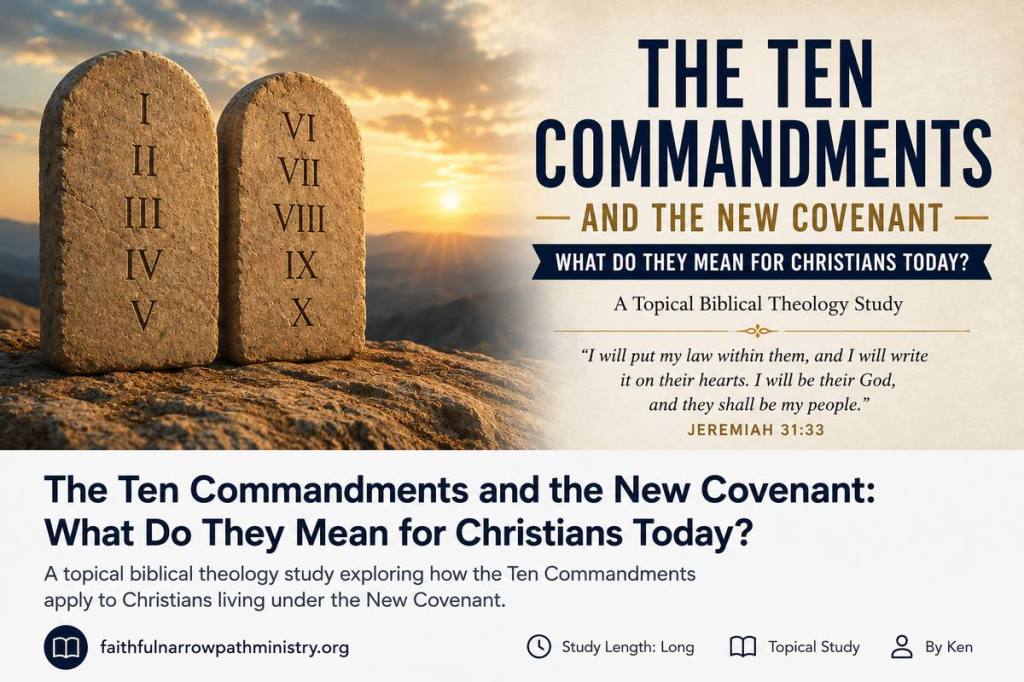
The Ten Commandments and the New Covenant
What Do They Mean for Christians Today?
Study Type: Topical Biblical Theology
This study is intentionally different from our usual passage focused expository Bible studies. Rather than working verse by verse through one primary passage, we are tracing a biblical question across several key texts:
How should Christians living under the New Covenant understand the Ten Commandments?
The question is not simply whether Christians should “keep” or “not keep” the Ten Commandments. We need to understand where they belonged within the Mosaic covenant, what changed with the coming of Christ, what Jesus meant when He said He came to fulfill the Law, and how the moral truth revealed in these commandments continues to shape Christian life.
Key Passages
Exodus 20:1 to 17
Jeremiah 31:31 to 34
Matthew 5:17 to 20
Romans 7:4 to 6
Romans 13:8 to 10
Colossians 2:16 to 17
Hebrews 8:6 to 13
The full ESV text of these passages is included in the Scripture Reading section at the end of this study.
The Question
Christians can fall into two opposite errors when thinking about the Ten Commandments.
One approach treats them as though very little changed with the coming of Christ. Christians are essentially placed back under Sinai, with little attention given to the covenantal change brought about through Christ.
The opposite approach reasons that because Christians are not under the Mosaic covenant, the Ten Commandments have little continuing relevance.
Neither approach does justice to the whole biblical picture.
The New Testament teaches that believers are no longer under the Mosaic covenant as the covenant governing their relationship with God. Christ has inaugurated the New Covenant, fulfilled the Law and the Prophets, and brought His people into a new covenantal relationship with God.
At the same time, the New Testament repeatedly affirms the moral truths expressed in the commandments.
So Christians are not under the Ten Commandments in precisely the same covenantal way Israel was at Sinai, but neither have the commandments become irrelevant.
To understand why, we need to start where God originally gave them.
The Ten Commandments in Their Original Covenant Setting
Exodus 20 does not begin with a command.
It begins with redemption.
God says:
“I am the LORD your God, who brought you out of the land of Egypt, out of the house of slavery.”
Exodus 20:2 (ESV)
That order matters.
God did not tell Israel to obey the commandments so that He would rescue them from Egypt. He rescued them first and then instructed them how His covenant people were to live.
The Ten Commandments were given within the covenant God established with Israel at Mount Sinai. They revealed God’s holy character and governed Israel’s relationship with Him and with one another.
The first commandments focus especially upon Israel’s relationship with God.
God alone was to be worshiped.
He was not to be represented through idols of human invention.
His name was to be treated as holy.
Israel was to observe the Sabbath.
The remaining commandments address human relationships.
Honor father and mother.
Do not murder.
Do not commit adultery.
Do not steal.
Do not bear false witness.
Do not covet.
These were not ten isolated moral sayings. They stood at the heart of Israel’s covenant life.
That covenant setting becomes essential once we reach the New Testament.
God Promised a New Covenant
The Old Testament itself anticipated that the Mosaic covenant would not remain the final form of God’s covenant administration.
Jeremiah declared:
“Behold, the days are coming, declares the LORD, when I will make a new covenant.”
Jeremiah 31:31 (ESV)
Jeremiah then says that this covenant would be:
“not like the covenant that I made with their fathers.”
Jeremiah 31:32 (ESV)
Something genuinely new was coming.
Yet Jeremiah also says:
“I will put my law within them, and I will write it on their hearts.”
Jeremiah 31:33 (ESV)
The New Covenant therefore does not mean that God becomes indifferent toward holiness or obedience.
The problem was never that God’s moral will was defective.
The problem was the sinful human heart.
The New Covenant promises forgiveness, inward renewal, and a changed relationship with God.
Hebrews 8 directly takes Jeremiah’s prophecy and applies it to the covenant mediated by Christ. It repeats God’s promise:
“I will put my laws into their minds, and write them on their hearts.”
Hebrews 8:10 (ESV)
Then Hebrews concludes:
“In speaking of a new covenant, he makes the first one obsolete.”
Hebrews 8:13 (ESV)
That statement needs to be taken seriously.
Christians do not relate to God through the Mosaic covenant.
The New Covenant has superseded the Mosaic covenant as the covenant under which God’s people now live.
From Old Covenant Israel to the New Covenant Church
This does not mean God abandoned one people and started over with an unrelated group.
There is continuity in God’s redemptive purpose.
The promises move through Abraham, Israel, David, and ultimately to Jesus Christ, Israel’s Messiah. The earliest New Covenant church consisted of Jewish believers who trusted in Israel’s promised Messiah. Believing Gentiles were then brought into the same redeemed people through Christ.
Paul describes Gentile believers as being grafted into the olive tree rather than receiving a completely unrelated plan of salvation in Romans 11:17 to 24.
Ephesians says that Gentile believers who were once strangers to the covenants of promise have been brought near through Christ and made:
“fellow citizens with the saints and members of the household of God.”
Ephesians 2:19 (ESV)
Galatians likewise teaches that those who belong to Christ are Abraham’s offspring according to promise in Galatians 3:26 to 29.
From a Reformed covenantal perspective, there is therefore one unfolding people of God across redemptive history, while the covenant administration changes decisively with the coming of Christ.
Old Covenant Israel and the New Covenant church are not identical in every respect, but neither are they two unrelated peoples with separate ways of salvation.
The promises given through Israel reach their fulfillment in Christ, and everyone who belongs to Christ, Jew or Gentile, shares in the blessings secured through Him.
Christ Fulfilled the Law
Jesus gives us an essential starting point:
“Do not think that I have come to abolish the Law or the Prophets; I have not come to abolish them but to fulfill them.”
Matthew 5:17 (ESV)
Jesus does not treat the Old Testament as a mistake that needed to be discarded.
He fulfills it.
The Law and the Prophets point toward Him, reach their goal in Him, and must now be understood in light of His person and work.
That means Christians should avoid two opposite conclusions.
We should not say:
The Old Testament law has nothing to do with Christians.
But neither should we say:
Nothing changed, so Christians remain under Sinai exactly as Israel was.
Christ fulfills the Law.
The New Testament therefore becomes our authoritative guide for understanding how the moral truth revealed under the Old Covenant applies to those who belong to Christ.
Released From the Law, Yet Called to Obedience
Paul writes:
“But now we are released from the law, having died to that which held us captive, so that we serve in the new way of the Spirit and not in the old way of the written code.”
Romans 7:6 (ESV)
That is strong language.
Believers have died to the law through the body of Christ and now belong to the risen Christ.
Yet Paul does not move from that truth into moral lawlessness.
He moves into service in the new way of the Spirit.
That distinction matters.
Christians are not justified by law keeping.
They are not under the Mosaic covenant as their covenantal administration.
But grace does not free Christians from obedience.
Grace puts obedience in its proper place.
We obey because God has saved us, not so that God will save us.
This is what Jeremiah anticipated when God promised to put His law within His people and write it on their hearts in Jeremiah 31:33 and Hebrews 8:10.
The promise does not mean Christians become perfectly obedient in this life. Sanctification remains incomplete. But God changes His people from within and produces a real desire for holiness and obedience.
Love and the Moral Law
Romans 13 makes clear that the moral substance of the commandments continues to matter under the New Covenant.
Paul writes:
“For the commandments, ‘You shall not commit adultery, You shall not murder, You shall not steal, You shall not covet,’ and any other commandment, are summed up in this word: ‘You shall love your neighbor as yourself.’”
Romans 13:9 (ESV)
Then:
“Love does no wrong to a neighbor; therefore love is the fulfilling of the law.”
Romans 13:10 (ESV)
Love does not replace holiness with vague kindness.
Biblical love fulfills the moral intention of God’s commands.
If I love my neighbor, I will not murder him.
If I love my neighbor, I will not commit adultery with his spouse.
If I love my neighbor, I will not steal from him.
If I love my neighbor, I will not lie about him.
If I love my neighbor, I will not resentfully desire what God has given him.
Jesus similarly summarizes the law through love for God and love for neighbor in Matthew 22:37 to 40.
The New Covenant does not lower the moral standard.
Jesus repeatedly shows that God’s commandments reach all the way into the heart.
The Ten Commandments Under the New Covenant
First Commandment: “You shall have no other gods before me.”
The first commandment requires exclusive loyalty to God.
Israel was surrounded by nations worshiping many gods. The Lord demanded that His covenant people worship Him alone.
That requirement clearly continues under the New Covenant.
Jesus says:
“You shall worship the Lord your God and him only shall you serve.”
Matthew 4:10 (ESV)
Most Christians today will never physically bow before Baal or Molech, but the sin forbidden by this commandment remains very real.
Idolatry occurs whenever something created is given the place in our hearts, loyalties, confidence, or devotion that belongs uniquely to the Creator.
Money, career, relationships, political power, possessions, approval, pleasure, or even self can become functional idols when we give them the ultimate trust, security, allegiance, or devotion that belongs to God alone.
These things are not necessarily sinful in themselves.
The problem comes when they take God’s place.
New Covenant principle: God alone deserves our worship, ultimate trust, and highest allegiance.
Second Commandment: “You shall not make for yourself a carved image…”
The second commandment concerns how God is worshiped.
Israel was forbidden from creating images and then treating those images as gods or as representations through which the true God would be worshiped.
The golden calf demonstrates the danger clearly. Israel attempted to approach and represent God through an image of human invention.
The enduring principle remains important.
God determines how He is known and worshiped.
We do not have the authority to reinvent Him according to our imagination, cultural preferences, or personal desires.
From a Reformed perspective, this commandment has historically carried particular importance in discussions about worship. Christians have differed over some applications, but the central principle is clear:
We worship God as He has revealed Himself, not as we would prefer Him to be.
Third Commandment: “You shall not take the name of the LORD your God in vain.”
This commandment concerns far more than casual profanity.
God’s name represents His character, authority, and reputation.
To misuse His name includes speaking falsely about Him, invoking Him dishonestly, using His name to manipulate others, or claiming His authority for things He has not said.
Christians bear the name of Christ.
That makes this commandment especially searching.
Our doctrine, speech, conduct, and public witness should not dishonor the One whose name we confess.
New Covenant principle: Treat God’s name, character, and revealed truth with reverence.
Fourth Commandment: “Remember the Sabbath day, to keep it holy.”
The fourth commandment requires more careful treatment because the New Testament addresses it differently from the other commandments.
Under the Mosaic covenant, Israel was commanded to cease from ordinary labor on the seventh day. The Sabbath also functioned as a covenant sign between God and Israel in Exodus 31:13 to 17.
When we reach the New Testament, Paul writes:
“Therefore let no one pass judgment on you in questions of food and drink, or with regard to a festival or a new moon or a Sabbath.”
Colossians 2:16 (ESV)
He continues:
“These are a shadow of the things to come, but the substance belongs to Christ.”
Colossians 2:17 (ESV)
So Christians are not simply placed under Israel’s Mosaic Sabbath regulations unchanged.
From the classic Reformed perspective, however, the fourth commandment contains an abiding moral principle.
God established a recurring pattern of worship and rest, and this principle is expressed under the New Covenant particularly through the Lord’s Day, the first day of the week associated with Christ’s resurrection and the gathering of His church.
Other conservative evangelicals understand the Sabbath command as having been fulfilled more completely in Christ and therefore do not regard one day in seven as morally binding in the same way.
That difference should be acknowledged.
Our Reformed leaning conclusion is that the moral pattern of setting apart regular time for worship and rest continues, while the Mosaic regulations governing Israel’s seventh day Sabbath are not imposed unchanged upon the church.
Whatever position a Christian takes on the precise continuity of the fourth commandment, the New Testament is clear that believers are to gather faithfully with the church and encourage one another in the faith in Hebrews 10:24 to 25.
New Covenant principle: Christians are not under Israel’s Mosaic Sabbath regulations, yet worship, gathered fellowship, and a God ordered rhythm of rest remain important features of faithful Christian life.
Fifth Commandment: “Honor your father and your mother.”
Paul directly repeats this commandment to Christians:
“Honor your father and mother.”
Ephesians 6:2 (ESV)
Children are called to obey their parents in the Lord, and the broader principle of honor does not simply disappear when someone becomes an adult.
Parents are not infallible, and honoring them does not require participating in sin or submitting to abuse.
But family relationships and God given responsibilities are not treated casually in Scripture.
New Covenant principle: Honor the God given responsibilities and relationships of family life.
Sixth Commandment: “You shall not murder.”
The New Testament clearly reaffirms the prohibition against murder.
Jesus also takes the commandment deeper by exposing the murderous roots that can exist within the heart.
Unrighteous anger, hatred, contempt, and bitterness reveal that the commandment concerns more than merely avoiding the physical act of killing in Matthew 5:21 to 22.
Human beings bear God’s image and therefore possess profound dignity.
New Covenant principle: Protect human life and reject the hatred, contempt, and hostility from which murder grows.
Seventh Commandment: “You shall not commit adultery.”
Jesus explicitly reaffirms this commandment and again exposes its heart level implications.
Adultery is not merely an outward act.
Jesus addresses lust as corruption within the heart that violates God’s intention for sexual faithfulness in Matthew 5:27 to 30.
The New Testament repeatedly calls Christians to sexual holiness.
Marriage is to be honored, and sexual intimacy belongs within the covenant of marriage.
New Covenant principle: Honor marriage and pursue sexual purity in both conduct and desire.
Eighth Commandment: “You shall not steal.”
The prohibition against stealing is also directly carried into New Covenant teaching.
Paul writes:
“Let the thief no longer steal, but rather let him labor, doing honest work with his own hands.”
Ephesians 4:28 (ESV)
But Paul goes further.
The transformed believer works:
“so that he may have something to share with anyone in need.”
Ephesians 4:28 (ESV)
Grace does more than stop the thief from taking.
It turns the taker into a giver.
New Covenant principle: Respect what belongs to others, work honestly, and practice generosity.
Ninth Commandment: “You shall not bear false witness against your neighbor.”
The original commandment particularly addresses false testimony that could seriously harm another person.
The broader biblical principle condemns deception and calls God’s people to truthfulness.
Paul tells believers:
“having put away falsehood, let each one of you speak the truth with his neighbor.”
Ephesians 4:25 (ESV)
Christians follow the One who identifies Himself as the truth.
Truthfulness should therefore characterize our speech even when dishonesty would be easier or personally advantageous.
New Covenant principle: Speak truthfully and refuse to use deception to harm others or protect yourself dishonestly.
Tenth Commandment: “You shall not covet…”
The final commandment makes unmistakably clear that God’s law reaches beyond outward behavior and into the desires of the heart.
Exodus does not limit coveting to another person’s spouse.
It speaks of a neighbor’s house, wife, servants, animals, and finally:
“anything that is your neighbor’s.”
Exodus 20:17 (ESV)
Coveting is a disordered desire for what God has given to another person.
That might involve someone else’s home, marriage, income, career, appearance, possessions, recognition, opportunities, family circumstances, influence, or lifestyle.
There is nothing inherently sinful about wanting a home, marriage, meaningful work, financial stability, or other legitimate blessings.
The problem comes when desire becomes envy, resentment, fixation, discontentment, or a willingness to sin in order to obtain what belongs to another.
Paul himself points to this commandment when explaining how the law exposed sin within his own heart in Romans 7:7.
New Covenant principle: Learn contentment, reject envy, and guard the desires of the heart.
What Changed Under the New Covenant?
The Ten Commandments remain deeply important, but the Christian relationship to them must be understood through Christ.
We are not standing at Sinai trying to establish our acceptance before God through covenant obedience.
We stand in Christ.
The Mosaic covenant has reached its fulfillment and given way to the New Covenant.
Christ has fulfilled the Law.
Our sins are forgiven through His sacrifice.
Our justification rests entirely upon Christ and His righteousness received through faith, never upon our commandment keeping in Romans 3:21 to 28 and Philippians 3:8 to 9.
The Holy Spirit gives new life and begins producing obedience from within.
The moral will of God therefore has not disappeared.
It increasingly becomes visible in the lives of His people.
This protects us from two opposite errors.
Legalism says: My obedience makes me acceptable to God.
Lawlessness says: Grace means obedience does not matter.
The gospel says something very different:
Christ alone is the ground of our acceptance before God, and the grace that saves us also begins transforming the way we live (Ephesians 2:8 to 10; Titus 2:11 to 14).
Christ Saves, the Spirit Renews, the Believer Walks
The order matters.
Titus 3 gives us a particularly clear picture.
God:
“saved us, not because of works done by us in righteousness, but according to his own mercy.”
Titus 3:5 (ESV)
Paul then speaks of:
“the washing of regeneration and renewal of the Holy Spirit.”
Only after describing salvation by mercy, regeneration, renewal, and justification by grace does Paul say that believers should:
“devote themselves to good works.”
Titus 3:8 (ESV)
So the biblical order is:
Christ saves.
The Spirit renews.
The believer then walks in obedience.
This same pattern appears in Ezekiel 36:26 to 27 and Ephesians 2:8 to 10.
We should never reverse it.
Good works do not produce salvation.
They are part of the transformed life that follows God’s saving work.
The Ten Commandments and Ongoing Sanctification
The Ten Commandments should not be something Christians read once, generally agree with, and then leave behind.
They provide an ongoing opportunity for self examination.
We return to God’s moral instruction not to ask whether we have finally become worthy of His acceptance, but to ask where our lives still need to be brought into greater conformity to His will.
The commandments continually expose more than outward behavior.
They ask about worship.
Desire.
Truthfulness.
Faithfulness.
Anger.
Contentment.
Family relationships.
The way we treat our neighbor.
And the loyalties of the heart.
No Christian perfectly obeys God in this life.
Scripture is clear:
“If we say we have no sin, we deceive ourselves, and the truth is not in us.”
1 John 1:8 (ESV)
But that reality must never become an excuse for spiritual complacency.
Those whom God justifies He also sanctifies.
Growth may be slow.
It may be uneven.
Some sins may require long battles.
But a Christian life should increasingly display repentance, obedience, love, holiness, and the fruit of the Holy Spirit in Romans 6:1 to 14, Galatians 5:16 to 25, and Philippians 2:12 to 13.
This distinction is important:
Our justification does not increase as our obedience improves.
God does not gradually become more willing to accept us as we perform better.
Our acceptance rests upon Christ.
But our sanctification should progress.
Over time, the life of someone who belongs to Christ should increasingly reflect the character and will of the God who saved them.
That means the Ten Commandments can serve as an ongoing mirror.
Not a mirror for comparing ourselves with other people.
A mirror for honestly examining ourselves before God.
Law, Grace, and Good Works
Reformed theology has historically made a helpful distinction concerning the purposes of God’s law.
The law exposes sin.
It restrains evil.
And for those who have been redeemed, it helps reveal the kind of life that pleases God.
But the law cannot regenerate the heart.
It cannot justify the sinner.
It cannot provide the righteousness necessary for acceptance before God.
Only Christ can do that.
This is why obedience must always follow grace rather than become the basis of grace.
Exodus itself already points us in that direction.
God first said:
“I am the LORD your God, who brought you out of the land of Egypt.”
Then He gave His commandments.
Redemption preceded obedience.
Under the New Covenant, that order becomes even clearer.
God saves His people through Christ.
The Spirit renews them from within.
Then they learn, imperfectly but genuinely, to walk in obedience.
Core Truth
Christians are not under the Mosaic covenant as Israel was, but the moral truth revealed in the Ten Commandments has not become irrelevant.
Jesus fulfilled the Law and inaugurated the New Covenant.
Those who belong to Him are justified by grace through faith, not by law keeping, and they now serve God in the new way of the Spirit.
The commandments therefore do not function as a ladder by which sinners climb toward God.
They reveal God’s holiness.
They expose sin.
They help us understand what love for God and love for neighbor actually looks like.
And for those who have been redeemed, they continue to provide moral instruction as the Holy Spirit progressively conforms us to Christ.
We do not obey in order to become redeemed.
We pursue obedience because God has redeemed us in Christ.
Application
When you read the Ten Commandments, resist the temptation to immediately ask:
How well am I doing compared with everyone else?
Start by allowing them to reveal something about God.
God alone deserves worship.
His name is holy.
Human life matters.
Marriage matters.
Truth matters.
Justice matters.
Family responsibilities matter.
Contentment matters.
Then allow the commandments to examine your heart.
Idolatry can exist without a statue.
Adultery can begin with lust.
Murderous hatred can exist without physical violence.
Stealing can reveal selfishness.
False witness can appear through exaggeration, manipulation, or convenient dishonesty.
Coveting can remain completely hidden from everyone except God.
This kind of examination should be ongoing.
Ask where your life increasingly reflects God’s will and where repentance is still needed.
When Scripture exposes sin, do not defend it.
Confess it.
Turn from it.
Then return to Christ.
The commandments show us why we need Him.
None of us has loved God perfectly.
None of us has loved our neighbor perfectly.
Our hope therefore cannot rest upon our record of obedience.
It rests upon Christ.
And because we belong to Him, obedience becomes the grateful response of people who have received mercy.
Challenge and Reflection
Work through the commandments honestly before God.
Is anything receiving the ultimate devotion, trust, or allegiance that belongs to God alone?
Am I worshiping God as He has revealed Himself, or reshaping Him according to what I would prefer Him to be?
Does the way I speak, teach, and live honor His name?
Am I giving proper priority to worship, fellowship, and a healthy rhythm of rest?
Do I honor the responsibilities and relationships God has established within family life?
Am I harboring hatred, bitterness, resentment, or contempt toward another person?
Am I pursuing faithfulness and purity in both actions and desires?
Am I honest with what belongs to others, and am I generous with what God has given me?
Is my speech truthful even when dishonesty would be easier?
Am I content with God’s provision, or am I consumed by what He has given someone else?
Do not answer these questions in order to establish your worth before God.
Answer them honestly because you belong to Christ.
Confess sin where Scripture exposes it.
Receive the forgiveness purchased by Christ.
Depend upon the Holy Spirit.
Then continue pursuing obedience from a heart being transformed by grace.
Closing Charge
The Ten Commandments still have much to teach Christians.
But we must read them from the right side of the cross.
Christ has fulfilled the Law.
The New Covenant has been established.
God’s people are justified by grace through faith, not by their obedience to the commandments.
Yet the God who saves His people also transforms them.
His grace does not produce indifference toward holiness.
It produces a growing love for God, love for neighbor, hatred of sin, and desire to walk according to His will.
Perfect obedience will not be ours in this life.
But neither should we become satisfied with remaining exactly where we are.
Return regularly to God’s Word.
Allow it to expose your heart.
Confess what needs to be confessed.
Thank God for where He has produced growth.
And keep pressing forward in sanctification.
Do not return to Sinai looking for a way to earn God’s acceptance.
Do not use grace as an excuse to ignore what God calls good.
Look to Christ.
Rest in His completed work.
Walk by the Spirit.
And let the life you live increasingly reflect the holiness, truth, love, and goodness of the God who has redeemed you.
Soli Deo Gloria
To God alone be the glory.
Scripture Reading
The following passages provide the primary biblical foundation for this topical study.
Exodus 20:1 to 17 (ESV)
The Ten Commandments
[1] And God spoke all these words, saying,
[2] “I am the LORD your God, who brought you out of the land of Egypt, out of the house of slavery.
[3] “You shall have no other gods before me.
[4] “You shall not make for yourself a carved image, or any likeness of anything that is in heaven above, or that is in the earth beneath, or that is in the water under the earth. [5] You shall not bow down to them or serve them, for I the LORD your God am a jealous God, visiting the iniquity of the fathers on the children to the third and fourth generation of those who hate me, [6] but showing steadfast love to thousands of those who love me and keep my commandments.
[7] “You shall not take the name of the LORD your God in vain, for the LORD will not hold him guiltless who takes his name in vain.
[8] “Remember the Sabbath day, to keep it holy. [9] Six days you shall labor, and do all your work, [10] but the seventh day is a Sabbath to the LORD your God. On it you shall not do any work, you, or your son, or your daughter, your male servant, or your female servant, or your livestock, or the sojourner who is within your gates. [11] For in six days the LORD made the heavens and the earth, the sea, and all that is in them, and rested on the seventh day. Therefore the LORD blessed the Sabbath day and made it holy.
[12] “Honor your father and your mother, that your days may be long in the land that the LORD your God is giving you.
[13] “You shall not murder.
[14] “You shall not commit adultery.
[15] “You shall not steal.
[16] “You shall not bear false witness against your neighbor.
[17] “You shall not covet your neighbor’s house; you shall not covet your neighbor’s wife, or his male servant, or his female servant, or his ox, or his donkey, or anything that is your neighbor’s.”
Jeremiah 31:31 to 34 (ESV)
The New Covenant
[31] “Behold, the days are coming, declares the LORD, when I will make a new covenant with the house of Israel and the house of Judah, [32] not like the covenant that I made with their fathers on the day when I took them by the hand to bring them out of the land of Egypt, my covenant that they broke, though I was their husband, declares the LORD. [33] For this is the covenant that I will make with the house of Israel after those days, declares the LORD: I will put my law within them, and I will write it on their hearts. And I will be their God, and they shall be my people. [34] And no longer shall each one teach his neighbor and each his brother, saying, ‘Know the LORD,’ for they shall all know me, from the least of them to the greatest, declares the LORD. For I will forgive their iniquity, and I will remember their sin no more.”
Matthew 5:17 to 20 (ESV)
Christ Came to Fulfill the Law
[17] “Do not think that I have come to abolish the Law or the Prophets; I have not come to abolish them but to fulfill them. [18] For truly, I say to you, until heaven and earth pass away, not an iota, not a dot, will pass from the Law until all is accomplished. [19] Therefore whoever relaxes one of the least of these commandments and teaches others to do the same will be called least in the kingdom of heaven, but whoever does them and teaches them will be called great in the kingdom of heaven. [20] For I tell you, unless your righteousness exceeds that of the scribes and Pharisees, you will never enter the kingdom of heaven.
Romans 7:4 to 6 (ESV)
[4] Likewise, my brothers, you also have died to the law through the body of Christ, so that you may belong to another, to him who has been raised from the dead, in order that we may bear fruit for God. [5] For while we were living in the flesh, our sinful passions, aroused by the law, were at work in our members to bear fruit for death. [6] But now we are released from the law, having died to that which held us captive, so that we serve in the new way of the Spirit and not in the old way of the written code.
Romans 13:8 to 10 (ESV)
Fulfilling the Law Through Love
[8] Owe no one anything, except to love each other, for the one who loves another has fulfilled the law. [9] For the commandments, “You shall not commit adultery, You shall not murder, You shall not steal, You shall not covet,” and any other commandment, are summed up in this word: “You shall love your neighbor as yourself.” [10] Love does no wrong to a neighbor; therefore love is the fulfilling of the law.
Colossians 2:16 to 17 (ESV)
Let No One Disqualify You
[16] Therefore let no one pass judgment on you in questions of food and drink, or with regard to a festival or a new moon or a Sabbath. [17] These are a shadow of the things to come, but the substance belongs to Christ.
Hebrews 8:6 to 13 (ESV)
[6] But as it is, Christ has obtained a ministry that is as much more excellent than the old as the covenant he mediates is better, since it is enacted on better promises. [7] For if that first covenant had been faultless, there would have been no occasion to look for a second.
[8] For he finds fault with them when he says:
“Behold, the days are coming, declares the Lord,
when I will establish a new covenant with the house of Israel
and with the house of Judah,
[9] not like the covenant that I made with their fathers
on the day when I took them by the hand to bring them out of the land of Egypt.
For they did not continue in my covenant,
and so I showed no concern for them, declares the Lord.
[10] For this is the covenant that I will make with the house of Israel
after those days, declares the Lord:
I will put my laws into their minds,
and write them on their hearts,
and I will be their God,
and they shall be my people.
[11] And they shall not teach, each one his neighbor
and each one his brother, saying, ‘Know the Lord,’
for they shall all know me,
from the least of them to the greatest.
[12] For I will be merciful toward their iniquities,
and I will remember their sins no more.”
[13] In speaking of a new covenant, he makes the first one obsolete. And what is becoming obsolete and growing old is ready to vanish away.
Scriptures Referenced
Primary and Key Passages: Exodus 20:1 to 17, Jeremiah 31:31 to 34, Matthew 5:17 to 20, Romans 7:4 to 6, Romans 13:8 to 10, Colossians 2:16 to 17, Hebrews 8:6 to 13
Additional References: Exodus 31:13 to 17, Exodus 32:1 to 8, Matthew 4:10, Matthew 5:21 to 30, Matthew 22:34 to 40, Romans 3:21 to 28, Romans 6:1 to 14, Romans 6:14, Romans 7:7, Romans 11:17 to 24, Romans 14:5 to 6, Ephesians 2:8 to 10, Ephesians 2:11 to 22, Ephesians 4:25 to 28, Ephesians 6:1 to 3, Galatians 3:26 to 29, Galatians 5:16 to 25, Philippians 2:12 to 13, Philippians 3:8 to 9, Titus 2:11 to 14, Titus 3:5 to 8, Hebrews 4:1 to 11, Hebrews 10:24 to 25, James 2:8 to 12, 1 John 1:8 to 10

Leave a Reply