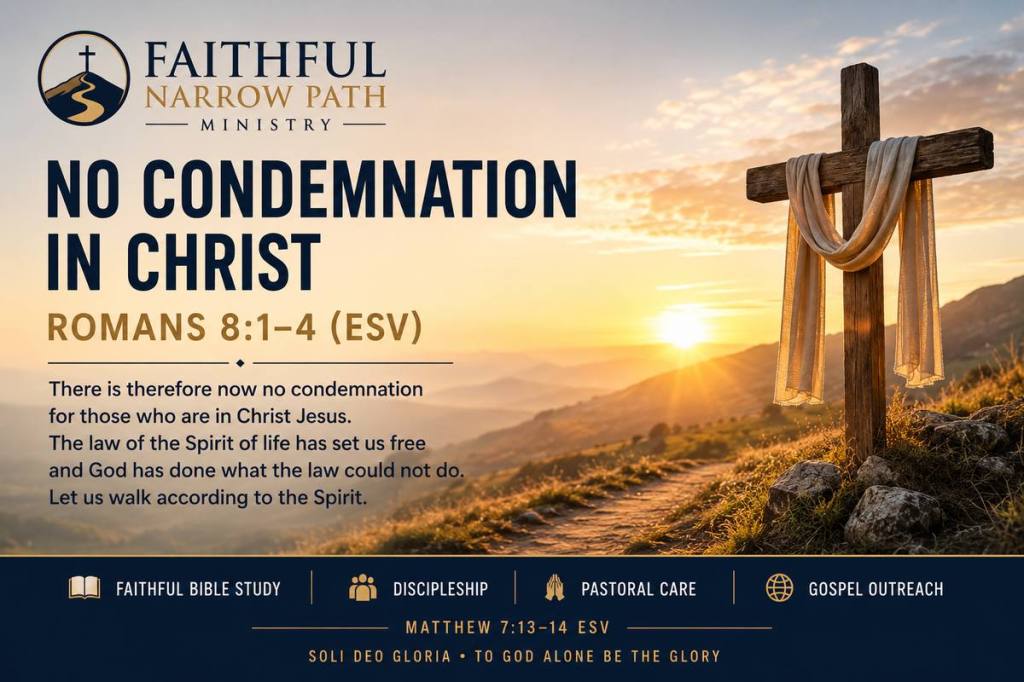
Scripture Reading
Romans 8:1–4
Life in the Spirit
[1] There is therefore now no condemnation for those who are in Christ Jesus. [2] For the law of the Spirit of life has set you free in Christ Jesus from the law of sin and death. [3] For God has done what the law, weakened by the flesh, could not do. By sending his own Son in the likeness of sinful flesh and for sin, he condemned sin in the flesh, [4] in order that the righteous requirement of the law might be fulfilled in us, who walk not according to the flesh but according to the Spirit.
Historical Background
Paul wrote Romans around AD 57, most likely from Corinth near the end of his third missionary journey. He addressed believers meeting in several house churches throughout Rome. These congregations included both Jewish and Gentile Christians. Although Paul had not yet visited them, he hoped to strengthen their faith, share in mutual encouragement, and prepare for future missionary work in Spain (Romans 1:10–15; 15:22–24; 16:3–16).
These believers lived at the center of the Roman Empire, where allegiance to Caesar, pagan worship, social status, and widespread immorality shaped public life. The churches had also experienced disruption after Emperor Claudius ordered Jews to leave Rome around AD 49 (Acts 18:2). Following his death, Jewish believers were able to return and worship alongside Gentile believers. This background helps explain Paul’s attention to the law, sin, grace, Israel, and unity among God’s people.
Paul wrote to explain the gospel carefully and extensively. He established that all humanity stands guilty under God’s righteous judgment. Neither possession of the law nor human effort can overcome sin or produce the righteousness God requires. Sinners are justified by God’s grace as a gift, received through faith in Jesus Christ apart from works of the law. Those united to Christ are then called to walk in newness of life by the power of the Holy Spirit.
Romans 8:1–4 follows Paul’s teaching concerning universal guilt, justification by faith, union with Christ, freedom from sin’s dominion, and the believer’s continuing conflict with remaining sin.
The declaration of “no condemnation” is not a universal promise given to everyone regardless of faith. It belongs specifically to those who are “in Christ Jesus.”
God acted through His Son to accomplish what His holy law could never accomplish through fallen human flesh. Salvation therefore rests entirely upon God’s gracious work in Christ, not upon human ability, obedience, or merit.
Literary Context
Romans 8:1–4 stands at a major turning point in Paul’s explanation of the gospel.
The word “therefore” connects its declaration of no condemnation to the argument developed throughout the preceding chapters.
Paul has shown that all people are under sin and accountable to God (Romans 1:18–3:20). He then explained that sinners are justified by grace through faith in Jesus Christ, apart from works of the law (Romans 3:21–5:21).
In Romans 6, Paul teaches that believers have been united with Christ in His death and resurrection. Grace does not give Christians permission to continue living under sin’s rule. Those who have died and risen with Christ are called to walk in newness of life (Romans 6:1–14).
Romans 7 then explains that God’s law is holy, righteous, and good, but it cannot deliver sinners from the power of sin. The weakness is not in the law but in fallen human beings, whose flesh prevents them from fulfilling its righteous demands.
Romans 7 closes with the cry:
“Wretched man that I am! Who will deliver me from this body of death?”
Paul immediately answers:
“Thanks be to God through Jesus Christ our Lord!”
Romans 7:24–25 (ESV)
Romans 8:1 then announces the result:
“There is therefore now no condemnation for those who are in Christ Jesus.”
The believer’s rescue does not come through greater human effort or more determined law keeping. It comes through God’s saving work in Jesus Christ.
Romans 8:1–4 also introduces the chapter’s emphasis on life in the Holy Spirit. Paul moves from freedom from condemnation to the Spirit’s work in those who belong to Christ.
The passage therefore holds justification and sanctification together without confusing them.
Believers are not freed from condemnation because they walk according to the Spirit. They walk according to the Spirit because God has united them to Christ, condemned sin in the flesh of His Son, and given them new life.
Their Spirit directed walk is the result of salvation, not its cause.
Scripture Breakdown
Romans 8:1
“There is therefore now no condemnation for those who are in Christ Jesus.”
“Therefore” points back to Paul’s preceding explanation of sin, justification, union with Christ, and deliverance through Jesus Christ. This assurance is not an isolated statement or a promise based on human optimism. It is the conclusion of the gospel Paul has carefully explained.
“Now” identifies a present reality.
Believers do not have to wait until the final judgment to discover whether Christ’s saving work was sufficient. Those who are in Him already possess a new standing before God.
Although they still struggle against remaining sin, the penalty their guilt deserves has been dealt with decisively through Christ.
“No condemnation” is a judicial declaration.
It does not mean believers never experience conviction, discipline, painful consequences, or sorrow over sin.
Conviction exposes sin and leads God’s children toward repentance. Condemnation is God’s righteous judgment against the guilty.
For those in Christ, that sentence has already been borne by their substitute, Jesus Christ (Romans 3:23–26; 5:8–9).
This promise belongs specifically to those who are “in Christ Jesus.”
To be in Christ is to be united with Him so that His death and resurrection define the believer’s standing before God.
They are not accepted because they have become morally perfect or have earned sufficient righteousness. They are accepted because their standing before God rests upon Christ and His saving work, received through faith (Romans 5:18–19; Philippians 3:8–9).
Paul’s statement is absolute:
There is no condemnation remaining for anyone who is in Christ.
The believer’s assurance rests upon Christ’s completed work and God’s unchanging verdict, not upon the strength of personal performance.
This truth does not make sin unimportant. It gives believers a secure foundation from which to confess sin, pursue holiness, and rest in the sufficiency of Christ.
Romans 8:2
“For the law of the Spirit of life has set you free in Christ Jesus from the law of sin and death.”
The word “for” explains why there is no condemnation for those who are in Christ.
Through the life giving work of the Holy Spirit, believers have been set free from the ruling power of sin and the death it produces.
Here, “law” refers to an operating power or principle.
“The law of the Spirit of life” describes the Spirit’s life giving power, while “the law of sin and death” describes the power that once held sinners in bondage.
Paul is not criticizing God’s moral law, which he has already called holy, righteous, and good (Romans 7:12).
This freedom is found only “in Christ Jesus.”
It does not come through human effort or moral improvement, but through God’s gracious work in Christ by the Holy Spirit.
Believers still struggle with sin, but sin no longer rules them as it once did.
Their obedience does not earn this freedom.
It flows from the freedom God has already given them in Christ.
Romans 8:3
“For God has done what the law, weakened by the flesh, could not do. By sending his own Son in the likeness of sinful flesh and for sin, he condemned sin in the flesh,”
God’s law is not defective.
It faithfully reveals His righteous standard and exposes human sin, but it cannot rescue sinners because fallen humanity is unable to obey it perfectly.
What sinful humanity could never accomplish through the law, God accomplished through His Son.
Jesus came “in the likeness of sinful flesh.”
He became truly human and entered a world corrupted by sin, yet He remained completely without sin (2 Corinthians 5:21; Hebrews 4:15).
Paul’s wording protects both Christ’s full humanity and His sinlessness.
God sent His Son “for sin.”
The phrase can carry sacrificial significance. Through Christ’s death, God dealt decisively with sin and condemned it in the flesh.
Jesus bore no guilt of His own. He willingly bore the judgment deserved by sinners.
Salvation therefore rests upon what God has done, not upon what human beings accomplish.
The Father sent the Son, and the Son took on human flesh to deal decisively with sin.
Christ bore the judgment deserved by sinners so that those united to Him would no longer stand condemned.
Romans 8:4
“in order that the righteous requirement of the law might be fulfilled in us, who walk not according to the flesh but according to the Spirit.”
God’s saving purpose includes more than freedom from condemnation.
Through the Holy Spirit, He produces in believers a new life directed toward the righteousness His law requires.
This obedience remains imperfect in this life, but it is real evidence of the Spirit’s transforming work.
To walk “according to the flesh” is to live under the controlling influence of fallen human nature.
To walk “according to the Spirit” is to live under the Spirit’s direction and power.
Paul is describing the distinguishing course of a believer’s life, not claiming that Christians never stumble or struggle with sin.
This Spirit directed walk is not the basis of justification but its necessary fruit.
Believers are not freed from condemnation because they have obeyed well enough. They walk according to the Spirit because God has united them to Christ and given them new life.
Grace does not merely pardon sinners.
It also begins transforming those whom God has saved.
Canonical Context
The promise of “no condemnation” agrees with the wider biblical teaching that those who believe in Christ have passed from judgment into life (John 3:18; 5:24).
This freedom is possible because Christ bore the curse of the law and became the sinless substitute for sinners (Galatians 3:13; 2 Corinthians 5:21; 1 Peter 2:24).
Scripture consistently teaches that God’s law is holy but cannot justify sinners or free them from sin’s power.
The law reveals sin and exposes human guilt, while salvation comes through faith in Jesus Christ (Romans 3:19–26; Galatians 3:21–24).
Christ accomplished through His once for all sacrifice what the repeated sacrifices of the old covenant could never accomplish (Hebrews 10:1–14).
The Spirit’s transforming work also fulfills God’s new covenant promise.
God promised to give His people new hearts, place His Spirit within them, and cause them to walk in His ways (Ezekiel 36:26–27).
This transformation originates in God and depends upon His power, yet it produces genuine and active obedience in those He saves.
Romans 8:1–4 therefore stands within the Bible’s unified message of redemption.
God justifies sinners through Christ and renews them through the Holy Spirit.
Their obedience neither earns nor completes Christ’s saving work.
It is the necessary fruit of God’s grace in those who have been united to His Son.
Biblical Theology
The need for freedom from condemnation begins with humanity’s fall into sin.
Adam’s disobedience brought sin, guilt, and death into the world, placing humanity under God’s righteous judgment (Genesis 3; Romans 5:12–19).
Fallen people cannot restore themselves to fellowship with God.
God’s law revealed His holy character and exposed human sin, but it could not change the sinful heart.
The sacrifices of the old covenant provided ceremonial cleansing and pointed beyond themselves to the need for a perfect and final sacrifice.
They could not permanently remove sin or cleanse the conscience (Leviticus 16; Hebrews 9:11–14; 10:1–4).
Through the prophets, God promised a new covenant in which He would forgive His people, give them new hearts, and place His Spirit within them (Jeremiah 31:31–34; Ezekiel 36:25–27).
Salvation would require both the removal of guilt and the inward renewal of the sinner.
Jesus fulfilled these promises through His obedient life, sacrificial death, and resurrection.
He bore the judgment sin deserved, and the Holy Spirit gives new life to those united to Him.
Romans 8:1–4 brings these truths together:
Believers are freed from condemnation through Christ and transformed through the Spirit.
God’s saving work will finally result in their complete freedom from sin and death.
Core Truth
There is now no condemnation for those who are united to Jesus Christ.
This verdict does not rest upon their moral performance but upon God’s saving work through His Son.
What the law could not accomplish because of fallen human flesh, God accomplished by sending Christ as the sinless substitute who bore sin’s judgment.
This freedom does not mean that believers become sinless or no longer need correction and repentance.
It means that the condemning judgment their sins deserve has been borne by Christ.
Their standing before God is secured by His completed work, not by the strength or consistency of their obedience.
The same God who justifies also gives new life through the Holy Spirit.
A Spirit directed life does not earn salvation, but it necessarily follows genuine union with Christ.
Believers pursue holiness from a place of acceptance in Christ, not in an attempt to earn acceptance from God.
Romans 8:1–4 therefore gives both assurance and a call to transformed living, while preserving the proper order:
Salvation first. Obedience as its fruit.
Application
If you are in Christ, your standing before God does not rise and fall with the quality of your performance.
When you sin, confess it honestly, turn from it, and seek renewed obedience.
But do not live as though Christ’s sacrifice must be completed by your efforts.
There is no condemnation remaining for those who belong to Him.
Learn to distinguish biblical conviction from condemning fear.
Biblical conviction agrees with God’s Word, identifies sin, and leads toward repentance and restored fellowship.
Condemning fear insists that Christ’s work was insufficient or that your failures have placed you beyond God’s grace.
Answer that fear with the truth of the gospel while continuing to take sin seriously.
Do not rely upon religious activity, moral improvement, or personal discipline to make yourself acceptable to God.
The law can expose your sin, but it cannot give you spiritual life.
Rest in what God has accomplished through Christ and depend upon the Holy Spirit for strength to obey.
Examine the direction of your life.
Walking according to the Spirit does not mean sinless perfection, but it does mean that God produces a genuine desire for holiness, repentance, and obedience.
These are fruits of salvation, never its basis.
If you are not in Christ, the promise of no condemnation does not yet belong to you.
Turn from sin and trust in Jesus Christ. His saving work is fully sufficient for everyone who comes to Him in faith.
Progress
Growth in the Christian life is not measured by sinless perfection but by a continuing, Spirit enabled movement toward holiness.
Believers still stumble and may endure difficult seasons of struggle, but the Spirit creates an ongoing conflict with sin rather than allowing them to remain comfortably surrendered to its rule.
He produces repentance, strengthens obedience, and gradually conforms God’s people to the character of Christ.
Progress may sometimes appear slow or uneven.
Do not measure God’s faithfulness only by how strong you feel on a particular day.
Look for a growing hatred of sin, a deeper trust in Christ, greater willingness to repent, and an increasing desire to obey God’s Word.
When you fail, do not return to self condemnation or attempt to earn your way back into God’s favor.
Confess your sin, remember your standing in Christ, and continue walking by the Spirit.
The security of “no condemnation” does not weaken the pursuit of holiness. It provides the foundation from which genuine progress becomes possible.
Encouragement
Your struggle with sin does not mean that Christ’s saving work has failed.
The grief you experience over sin and your desire to turn from it may be evidence of the Spirit working within you.
Your assurance, however, must rest finally upon Christ and His completed work, not upon the strength of your emotions or the consistency of your progress.
When your conscience reminds you of past or present failures, remember that God already knows the full extent of your sin.
Christ did not wait for you to make yourself worthy.
He saved you according to His grace, bore the judgment you deserved, and gave you a new standing before God.
You may feel weak, but the sufficiency of Christ does not depend upon the strength of your faith.
A weak faith may still rest upon a perfectly sufficient Savior.
Continue confessing sin, trusting His promises, and walking by the Spirit.
For everyone who is in Christ Jesus, God’s verdict remains:
No condemnation.
Challenge & Reflection
Consider where you are seeking assurance.
Are you resting in Christ’s completed work, or measuring God’s acceptance by your recent successes and failures?
Romans 8:1 calls you to place your confidence in God’s verdict rather than your changing performance.
At the same time, do not use “no condemnation” as permission to ignore sin.
The grace that justifies also brings believers under the transforming work of the Holy Spirit.
Ask whether your life shows a growing willingness to confess sin, turn from it, and obey God’s Word.
Reflect honestly:
Am I trusting Christ alone for my acceptance before God?
Do I respond to sin with repentance or excuses?
Am I depending upon the Holy Spirit or primarily upon my own determination?
Does the direction of my life show a growing desire to obey God?
When I fail, do I return to Christ or retreat into self condemnation?
Bring your confessed sin and weakness before God.
Rest in Christ’s sufficient work, and ask the Holy Spirit to continue producing genuine obedience in your life.
Closing Charge
Stand firmly upon God’s declaration that there is no condemnation for those who are in Christ Jesus.
Do not place your confidence in your performance, and do not allow past failures to speak more loudly than Christ’s completed work.
Confess your sin, trust His sufficient sacrifice, and rest in the righteousness that comes through faith in Him.
Then rise and walk according to the Spirit.
Pursue holiness not to earn God’s acceptance, but because you have received grace and new life in Christ.
Let the assurance of the gospel strengthen your obedience, deepen your humility, and keep your eyes fixed upon Jesus.
Our freedom from condemnation begins with God’s gracious purpose, rests upon Christ’s completed work, and is applied through the life giving power of the Holy Spirit. Salvation belongs entirely to the Lord.
Soli Deo Gloria
To God alone be the glory.
Scriptures Referenced
Primary Passage
Romans 8:1–4
Historical Background & Literary Context
Romans 1:10–15
Romans 1:18–3:20
Romans 3:21–5:21
Romans 6:1–14
Romans 7:12, 24–25
Romans 15:22–24
Romans 16:3–16
Acts 18:2
Scripture Breakdown & Canonical Context
John 3:18
John 5:24
Romans 3:19–26
Romans 5:8–9
Romans 5:18–19
Romans 7:12
2 Corinthians 5:21
Galatians 3:13
Galatians 3:21–24
Philippians 3:8–9
Hebrews 4:15
Hebrews 10:1–14
1 Peter 2:24
Ezekiel 36:26–27
Biblical Theology
Genesis 3
Leviticus 16
Jeremiah 31:31–34
Ezekiel 36:25–27
Romans 5:12–19
Hebrews 9:11–14
Hebrews 10:1–4

Leave a Reply