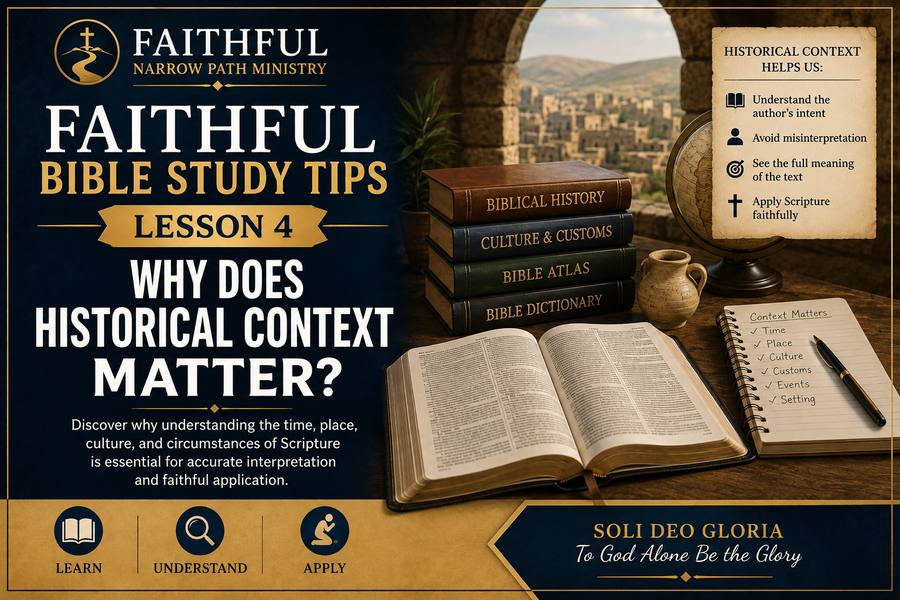
Faithful Bible Study Tips
Lesson 4: Why Does Historical Context Matter?
Lesson 3 defined historical context as the time, place, culture, customs, events, and circumstances surrounding a biblical passage.
In this lesson, we intentionally return to that subject, but for a different reason.
Lesson 3 answered:
What is historical context?
Lesson 4 asks:
Why does it matter so much for faithful interpretation?
The answer is simple:
Because Scripture was revealed within real history.
God’s Word is timelessly true, but it was not given in a timeless vacuum. Biblical authors wrote to real people living in specific places, under particular political powers, within distinct cultures, and often in response to real problems.
Understanding those circumstances can protect us from serious interpretive mistakes.
Historical Context Helps Us Hear the Passage More Accurately
When we read Scripture today, we naturally bring our own world with us.
We live in a modern culture.
We have our own assumptions about government, marriage, work, family, religion, economics, social customs, and even the meaning of certain words.
The original audience lived in a very different world.
Historical context helps us temporarily step outside our own assumptions and ask:
How would this message have sounded to the people who first received it?
That question does not make Scripture less relevant to us.
It helps us understand it more accurately before applying it to ourselves.
It Helps Explain Why the Author Said What He Said
Biblical authors did not write randomly.
Their words often addressed actual circumstances.
Paul wrote to churches struggling with division, false teaching, sexual immorality, persecution, doctrinal confusion, and questions about Christian living.
The prophets addressed idolatry, covenant unfaithfulness, foreign invasion, exile, judgment, and restoration.
Jesus taught within first-century Jewish life under Roman rule.
The historical situation frequently explains why certain teachings receive such urgency or emphasis.
Knowing what was happening around a passage can help answer:
Why is the author addressing this subject here?
That question often opens the passage in ways that isolated verse reading cannot.
It Protects Us From Importing Modern Assumptions
One of the greatest dangers in interpretation is assuming that ancient people thought exactly the way we do.
They did not.
Their world included customs, institutions, political realities, social expectations, and religious practices that may feel unfamiliar to us.
Without historical context, we can unknowingly impose twenty-first-century meanings onto first-century or Old Testament situations.
That can distort the text.
For example, a modern reader may encounter language involving:
- Household relationships
- Slavery or servitude
- Marriage customs
- Honor and shame
- Patronage
- Roman citizenship
- Temple worship
- Jewish ceremonial practices
- Agricultural life
- Ancient warfare
If we assume those things functioned exactly as their modern counterparts do, we may misunderstand what the text is addressing.
Historical context helps us ask better questions before drawing conclusions.
It Helps Us Understand Commands More Faithfully
Historical context can clarify why a command was given and what problem it addressed.
That does not mean commands become optional whenever we discover a cultural setting.
It means we first determine what the author was actually commanding.
Consider Paul’s instructions to particular churches.
Some commands address problems that were especially visible in one congregation.
Others express broader Christian obligations that clearly extend beyond that setting.
Historical context helps us distinguish between:
the specific circumstance being addressed
and
the enduring truth expressed through the command
Without that step, we may either universalize something too quickly or dismiss something too quickly.
Both errors can be avoided by careful interpretation.
It Helps Us Understand Warnings
Warnings often become clearer when we understand the danger behind them.
A repeated warning against false teachers makes more sense when we know false teaching was actively threatening a church.
A prophetic warning of judgment becomes clearer when we understand the covenant rebellion occurring at the time.
A warning against idolatry carries additional weight when believers lived among temples, pagan worship, and social pressure to participate.
Historical context shows us that biblical warnings were not abstract theological exercises.
They addressed real dangers.
It Helps Us Understand Promises Without Misusing Them
Historical context is especially important when reading promises.
Some promises were given during exile.
Some were tied to Israel’s covenant life.
Some were spoken to kings.
Some were connected to specific acts of judgment or restoration.
Some were given directly to the apostles.
Others clearly belong to all believers in Christ.
Historical context helps us understand the promise in its original setting before asking how it relates to God’s people today.
This guards against two opposite mistakes:
claiming a promise in a way Scripture never intended
or
assuming a promise has nothing to teach us because it was first given to someone else
Faithful interpretation avoids both extremes.
Example: Jeremiah 29
We touched on Jeremiah 29 in Lesson 3, and we return to it here intentionally because it demonstrates the difference between merely knowing the background and understanding why that background matters.
Jeremiah was writing to Jewish exiles in Babylon.
That is the historical fact.
But why does it matter?
Because it changes how we hear the chapter.
The exiles were being told to settle down, build houses, plant gardens, raise families, and seek the welfare of the city where God had sent them.
They were also told that their exile would not end immediately.
The well-known promise in Jeremiah 29:11 comes within that larger situation.
Understanding the exile keeps us from treating the verse as a detached promise that every individual plan will unfold exactly as we desire.
Instead, we see something richer:
God remained faithful to His covenant purposes even while His people were living under discipline in a foreign land.
The historical setting does not weaken the promise.
It helps us understand what kind of promise it is.
Example: Philippians
We also mentioned Paul’s imprisonment in Lesson 3.
Again, the repetition is intentional.
Lesson 3 established the fact.
Lesson 4 asks what difference that fact makes.
Paul writes about joy, contentment, courage, suffering, gospel advancement, and standing firm while he himself is imprisoned.
That historical reality deepens our understanding of his words.
When Paul speaks of rejoicing, he is not giving advice from a life free of hardship.
When he speaks of the gospel advancing, he does so while confined.
When he encourages believers not to be frightened by opponents, he understands suffering personally.
Historical context helps us hear the force of the message.
Example: Revelation
Revelation also demonstrates why historical context matters.
The book was originally sent to seven churches in Asia Minor.
Those churches lived under Roman rule and faced pressures involving idolatry, emperor worship, compromise, persecution, false teaching, and spiritual complacency.
Knowing that does not settle every interpretive question in Revelation.
But it immediately reminds us that the book was not written merely as a puzzle for Christians thousands of years later.
It was also intended to strengthen real churches facing real pressure to remain faithful to Christ.
That historical reality should remain part of our interpretation.
It Helps Us Recognize the Weight of Certain Words
Sometimes a word or phrase carries significance because of the historical world surrounding it.
Consider statements about:
Caesar
kingdom
Lord
citizenship
temple
exile
slavery
inheritance
adoption
These ideas existed within political, legal, social, and religious systems familiar to the original readers.
Understanding that background can add clarity to the biblical author’s point.
But there is an important caution.
Historical background should illuminate the text.
It should not become an excuse to invent hidden meanings that the text itself does not support.
Historical Context Can Correct a Familiar Interpretation
Sometimes we become so familiar with a verse that we stop asking what it meant in its original setting.
Historical context can challenge that familiarity.
That can feel uncomfortable.
But faithful Bible study requires us to allow Scripture to correct our assumptions.
If the historical setting shows that we have been using a passage in a way disconnected from its original meaning, the appropriate response is not to ignore the context.
It is to adjust our interpretation.
The goal is not to preserve our favorite reading.
The goal is to understand God’s Word faithfully.
Historical Context Helps Application Become Stronger
Some people worry that emphasizing historical context makes Scripture less practical.
The opposite is usually true.
Weak interpretation produces weak application.
If we misunderstand what a passage meant, our application may be built on something the passage never taught.
But when we understand the original message clearly, we can identify the enduring truth more responsibly.
The progression is:
Historical setting → original meaning → enduring biblical truth → faithful application
The better we understand the first steps, the stronger the final application becomes.
Historical Context Is Not an Escape Hatch
There is another danger worth addressing.
Sometimes people appeal to culture or history simply because they do not like what Scripture teaches.
They may say:
“That was just cultural.”
But identifying a historical setting does not automatically limit a command or teaching to that setting.
Every biblical passage has historical context.
The question is whether the text itself indicates that the teaching is temporary, culturally specific, covenantally limited, or broadly binding.
Historical context helps answer that question.
It should never be used as a shortcut for dismissing an uncomfortable teaching.
Do Not Let Background Information Overpower the Text
Historical study can become fascinating.
It is easy to spend more time studying Roman history, ancient customs, archaeology, or cultural practices than studying the passage itself.
That reverses the proper order.
Historical resources are servants.
Scripture is the authority.
If background information helps explain the text, use it.
If it is interesting but irrelevant, leave it aside.
If scholars disagree about a historical detail, do not build a major theological conclusion upon an uncertain reconstruction.
Our confidence rests in the inspired text, not in our ability to reconstruct every detail of the ancient world.
A Good Historical Context Check
When you think you have found an important historical detail, ask:
Does this information actually clarify something in the passage?
Is the information reasonably well established?
Does the biblical text itself support the connection I am making?
Am I using the background to explain the text, or am I using it to replace the text?
Those questions can keep historical study disciplined.
A Practical Example of the Process
Suppose you are studying one of Paul’s letters.
Before drawing application, briefly ask:
Where was Paul?
Who was receiving the letter?
What was happening in that church?
What political or religious pressures existed?
What problem or question prompted this section?
Then return immediately to the passage.
Ask:
How does knowing those things clarify what Paul is saying?
That final question is crucial.
Historical information becomes useful when it helps us understand the text.
Core Principle
Historical context matters because meaning is communicated within real circumstances.
Knowing the historical setting helps us hear Scripture more closely to the way its first readers heard it, guards us from importing modern assumptions, and gives us a stronger foundation for faithful application.
Closing Reminder
Lesson 3 taught us what historical context is.
Lesson 4 has intentionally revisited the same subject to show why it matters.
That repetition is part of the progression.
We first identify the setting.
Then we ask what difference that setting makes.
Historical context helps us understand why a passage was written, why certain issues receive emphasis, how commands and promises should be approached, and how the original message leads toward faithful application today.
Do not study the ancient world merely to accumulate information.
Study it when it helps you understand the Word.
Know the setting. Understand the message. Apply the truth faithfully.
Up Next
Lesson 5: What Is Literary Context?
Historical context helps us understand the world around a passage.
Next, we move closer to the text itself.
In Lesson 5, we will examine literary context and learn why a verse must be understood within its paragraph, chapter, book, and the author’s larger flow of thought.
✝️ Soli Deo Gloria – To God Alone Be the Glory

Leave a comment