📖 Scripture Reading
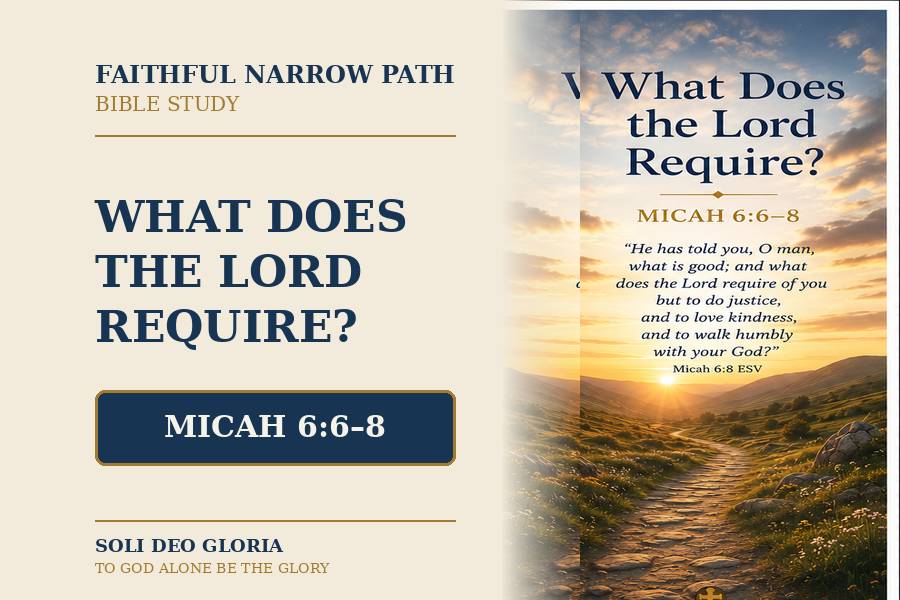
Micah 6:6–8 (ESV)
“With what shall I come before the LORD,
and bow myself before God on high?
Shall I come before him with burnt offerings,
with calves a year old?
Will the LORD be pleased with thousands of rams,
with ten thousands of rivers of oil?
Shall I give my firstborn for my transgression,
the fruit of my body for the sin of my soul?”
He has told you, O man, what is good;
and what does the LORD require of you
but to do justice, and to love kindness,
and to walk humbly with your God?
🔥 Opening
If you could ask one question that summarizes true religion, this might be it:
What does God actually desire from His people?
More sacrifices?
More religious activity?
More outward displays of devotion?
Through the prophet Micah, God gives an answer that still speaks powerfully today.
God is not impressed by religious activity that is disconnected from a heart that belongs to Him.
He desires a life transformed by His grace and increasingly marked by justice, kindness, and humble fellowship with Him.
Historical Context
Micah ministered during the eighth century BC, during a period of serious spiritual and moral decline in Israel and Judah.
Religious activity continued, but injustice, corruption, idolatry, and covenant unfaithfulness were widespread.
Micah 6 takes the form of a covenant lawsuit. God calls His people to account and reminds them of His faithfulness toward them.
He had redeemed, guided, and preserved His people.
Yet instead of responding with covenant faithfulness, they had drifted into outward religion while neglecting the character and obedience God desired.
In verses 6–7, the speaker asks what could possibly be brought before God.
The proposed offerings become increasingly extravagant.
Micah’s answer in verse 8 exposes the problem.
God had already made His will known.
The issue was not that sacrifice itself was wrong. God had instituted sacrifice under the covenant.
The problem was attempting to substitute religious performance for genuine faithfulness to God.
Scripture Breakdown
Micah 6:6 — What Can I Bring?
“With what shall I come before the LORD, and bow myself before God on high?”
The question begins appropriately.
How should sinful people approach a holy God?
But the focus quickly turns toward what the worshiper can offer.
“Shall I come before him with burnt offerings, with calves a year old?”
The thinking begins to center on religious performance rather than the condition of the heart.
Micah 6:7 — More Religion Cannot Fix the Heart
“Will the LORD be pleased with thousands of rams, with ten thousands of rivers of oil?”
The proposals become deliberately extreme.
Thousands of sacrifices.
Rivers of oil.
Then the speaker reaches the horrifying suggestion of offering a firstborn child.
Micah is exposing the absurdity of believing that greater religious sacrifice can compensate for covenant unfaithfulness.
God cannot be bought.
Human beings cannot atone for their own sin by offering increasingly impressive acts of religion.
External worship without genuine faith and obedience is empty.
Micah 6:8 — What the Lord Requires
“He has told you, O man, what is good.”
God’s will was not hidden from His people.
He had revealed how covenant faithfulness was to shape their lives.
Micah identifies three characteristics.
To do justice.
God’s people are called to act rightly and fairly toward others, reflecting the righteous character of God.
To love kindness.
The word carries the idea of steadfast, covenantal kindness and loyal love.
God’s people are not merely to perform occasional acts of kindness.
They are to value and love the kind of steadfast mercy and faithfulness that reflects God’s own character.
To walk humbly with your God.
This brings everything back to the relationship at the center of covenant life.
Walking humbly with God means living in dependence upon Him rather than self-sufficiency, pride, or outward religious performance.
Justice, kindness, and humility do not earn salvation.
They characterize lives that have been brought into genuine relationship with God.
Canonical Context
Micah’s message fits a pattern found throughout Scripture.
God repeatedly rebukes outward worship that is separated from genuine faith and obedience.
The prophets condemn sacrifices offered by people whose lives are characterized by injustice and rebellion.
Jesus later confronts the same problem among religious leaders who were careful about outward observance while neglecting what He called “the weightier matters of the law.”
Scripture does not oppose worship, obedience, or good works.
It opposes the belief that outward religious performance can substitute for a heart reconciled to God.
Biblical Theology
Micah 6:8 must never be separated from the Bible’s broader teaching about salvation.
Doing justice, loving kindness, and walking humbly with God are not a formula for earning acceptance before Him.
Sinful people cannot establish their own righteousness through moral behavior.
The gospel reveals that salvation is entirely by God’s grace through faith.
Ephesians 2:8–10 makes that order clear.
We are saved by grace, not by works.
Then, having been saved, we are created in Christ Jesus for good works.
Grace comes first.
Good works follow.
Therefore, the life described in Micah 6:8 is not the root of salvation.
It is fruit produced in those whose lives are being transformed by God.
🎯 Core Truth
God is not satisfied with outward religious activity disconnected from genuine faith.
He desires people who know Him and whose lives increasingly reflect His character through justice, steadfast kindness, and humble dependence upon Him.
We do not live this way to earn His grace.
We live this way because His grace transforms His people.
🧭 Application
It is possible to appear deeply religious while neglecting the very things God values.
Church attendance.
Bible knowledge.
Generous giving.
Faithful service.
These are good things.
But none can replace genuine fellowship with God or excuse a life characterized by pride, injustice, or lack of love toward others.
The question is not simply:
How much Christian activity am I doing?
A better question is:
What kind of person is God shaping me to become?
Is my faith changing the way I treat people?
Am I increasingly committed to what is right?
Do I love kindness?
Am I walking humbly with God, or quietly depending upon myself?
Supporting Scripture — Ephesians 2:8–10 (ESV)
“For by grace you have been saved through faith. And this is not your own doing; it is the gift of God, not a result of works, so that no one may boast. For we are his workmanship, created in Christ Jesus for good works, which God prepared beforehand, that we should walk in them.”
The order matters.
We are not saved by good works.
We are saved for good works.
The transformed life is the result of God’s saving grace, not the price we pay to receive it.
📈 Progress
Spiritual maturity is measured by more than outward religious appearance.
As believers grow in Christ, His transforming work becomes increasingly visible in ordinary life.
Justice becomes more important.
Kindness becomes more natural.
Pride is increasingly confronted.
Dependence upon God deepens.
Growth does not mean perfection.
It means that God is progressively shaping His people to reflect His character.
🙏 Encouragement
God is not calling His people to impress Him through endless religious performance.
He calls us to walk with Him.
Our acceptance before God does not rest upon how impressive our religious record appears.
For those who belong to Christ, it rests upon Christ.
And the God who saves His people is also at work transforming them.
He does not merely command justice, kindness, and humility.
By His grace, He increasingly produces those qualities in the lives of His people.
🤔 Challenge and Reflection
Is my faith visible primarily through religious activity?
Or is it increasingly evident in the way I treat other people?
Where do I need to pursue what is right rather than what is convenient?
Do I merely practice occasional kindness, or am I learning to love kindness?
Where is pride keeping me from walking humbly with God?
Am I trusting in Christ alone for my acceptance before God while allowing His grace to transform the way I live?
⚖️ Closing Charge
The Christian life is not about doing more in order to earn God’s favor.
It is about walking faithfully with the God who has already shown abundant grace.
Do justice.
Love kindness.
Walk humbly with your God.
Not as a way of purchasing His mercy, but as the fruit of a life being transformed by it.
✝️ Soli Deo Gloria – To God Alone Be the Glory
Every act of justice.
Every expression of kindness.
Every step of humble obedience.
All testify to the transforming work of God’s grace within His people.
He alone saves.
He alone transforms.
He alone deserves the glory.
To God alone be the glory.
📚 Scriptures Referenced
Micah 6:6–8
Ephesians 2:8–10

Leave a comment