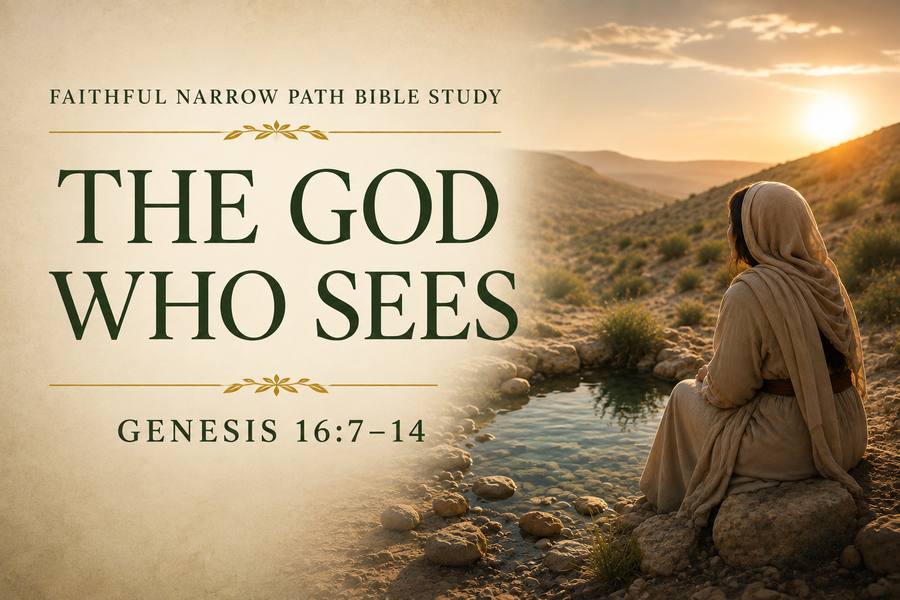
📖 Scripture Reading
Genesis 16:7–14 (ESV)
[7] The angel of the LORD found her by a spring of water in the wilderness, the spring on the way to Shur. [8] And he said, “Hagar, servant of Sarai, where have you come from and where are you going?” She said, “I am fleeing from my mistress Sarai.” [9] The angel of the LORD said to her, “Return to your mistress and submit to her.” [10] The angel of the LORD also said to her, “I will surely multiply your offspring so that they cannot be numbered for multitude.” [11] And the angel of the LORD said to her,
“Behold, you are pregnant
and shall bear a son.
You shall call his name Ishmael,
because the LORD has listened to your affliction.
[12] He shall be a wild donkey of a man,
his hand against everyone
and everyone’s hand against him,
and he shall dwell over against all his kinsmen.”
[13] So she called the name of the LORD who spoke to her, “You are a God of seeing,” for she said, “Truly here I have seen him who looks after me.” [14] Therefore the well was called Beer-lahai-roi; it lies between Kadesh and Bered.
🔥 Opening
Have you ever wondered whether God sees what you are going through?
Have you ever felt forgotten, unnoticed, or overlooked?
Difficult seasons can make us question whether God is aware of our circumstances or whether He is at work in them.
Genesis 16 gives a clear answer.
God sees what others miss. He knows what others overlook. He remains present and sovereign even when life is painful and confusing.
The question is not whether God sees.
The question is whether we will trust His character when we cannot yet understand His purposes.
Historical Context
Genesis 16 takes place after God had promised Abram descendants as numerous as the stars.
Yet time passed, and Abram and Sarai still had no child.
Rather than waiting on God’s timing, Sarai proposed a plan consistent with ancient Near Eastern custom. She gave Hagar, her servant, to Abram in an attempt to obtain offspring through human effort.
The result was conflict, jealousy, mistreatment, and suffering.
Hagar eventually fled into the wilderness.
The original audience of Genesis, the people of Israel, would have recognized an important truth in this account: God’s covenant purposes do not depend on human perfection.
Abram and Sarai acted impatiently. Hagar suffered within the consequences of those decisions. Yet God remained sovereign, faithful, and fully aware of every part of the situation.
Scripture Breakdown
Genesis 16:7–8 — God Finds Hagar
“The angel of the LORD found her by a spring of water in the wilderness.”
Hagar was alone, vulnerable, and far from the household she had fled.
Yet God knew exactly where she was.
The text does not present Hagar as searching for God.
God found her.
That detail reveals something important about His character. No person and no circumstance falls outside His knowledge.
Genesis 16:9 — God Gives Direction
“Return to your mistress and submit to her.”
God’s response was not simply to reassure Hagar emotionally.
He gave her difficult instruction.
God’s care does not always mean immediate escape from hardship. Sometimes His purposes include obedience in circumstances we would not choose.
That does not make suffering good, but it reminds us that God’s wisdom reaches beyond what we can immediately see.
Genesis 16:10–12 — God Reveals His Purpose
God promised that Hagar’s offspring would be multiplied and told her that she would bear a son named Ishmael.
The name Ishmael points to the fact that the LORD had listened to her affliction.
Hagar’s suffering was not hidden from Him.
God was not approving every human decision that led to this moment. He was demonstrating that even amid human sin and failure, His sovereign purposes continued.
Genesis 16:13 — The God Who Sees
“So she called the name of the LORD who spoke to her, ‘You are a God of seeing.’”
This is the heart of the passage.
Hagar’s circumstances were not instantly removed.
She was still facing a difficult road.
But she had learned something deeper about God.
He saw her.
He knew her affliction.
He had not abandoned her.
Genesis 16:14 — A Place Remembered
The well was called Beer-lahai-roi, a name connected to the living God who sees.
The location became a lasting reminder of God’s encounter with Hagar.
What had been a place of fear and uncertainty became a testimony to God’s presence and care.
Canonical Context
The truth revealed in Genesis 16 appears throughout Scripture.
Psalm 139 teaches that God searches, knows, and sees His people completely.
Psalm 34:15 says:
“The eyes of the LORD are toward the righteous and his ears toward their cry.”
Jesus later reminds His disciples that not even a sparrow falls apart from the Father’s knowledge and care.
God’s sight is not distant observation.
He knows His people personally and governs all things according to His wisdom.
Biblical Theology
Scripture consistently presents God as both sovereign and personal.
He rules over history, yet He also sees individual people in their suffering.
Genesis 16 also reminds us that God’s purposes are not overturned by human failure.
Abram and Sarai acted outside of faithful patience, and the consequences were real. Yet God’s covenant promise continued.
This pattern appears throughout Scripture.
Human beings fail.
God remains faithful.
His promises rest upon His character, not upon human strength or perfection.
Core Truth
The God who sees is also the God who acts according to His perfect wisdom.
Nothing escapes His attention.
No circumstance surprises Him.
No suffering is hidden from Him.
His knowledge is complete, His rule is sovereign, and His purposes remain faithful.
Hagar discovered in the wilderness that she was not unseen.
The same God remains unchanged.
Application
There are seasons when we feel forgotten, overlooked, or uncertain about what God is doing.
Genesis 16 reminds us that God’s care is not measured by our feelings or by how quickly circumstances improve.
Long before Hagar recognized His presence, God already saw her.
The same is true for His people today.
God sees our struggles, disappointments, fears, and uncertainties.
That does not mean every hardship immediately disappears.
It means none of it escapes His attention or falls outside His sovereign rule.
Because God sees, we can trust Him even when we do not fully understand what He is doing.
Progress
Spiritual maturity grows as we learn that God’s faithfulness does not depend upon our perfection.
Genesis 16 is filled with human weakness, impatience, and failure.
Yet God remained faithful.
Growth comes as we increasingly trust His character instead of judging His faithfulness by our circumstances.
We may not understand every season.
But we can know the God who governs it.
Encouragement
If you feel overlooked today, remember that you are not unseen by God.
The Lord who found Hagar in the wilderness still sees His people.
Jesus reminds us that the Father knows even the smallest details of His creation and that His people are of far greater value than many sparrows.
The God who sees is also the God who cares.
Challenge and Reflection
Am I allowing my circumstances to define my view of God?
Or am I allowing God’s revealed character to shape how I view my circumstances?
Where am I struggling to trust God because I cannot see what He is doing?
What would it look like to trust His wisdom and sovereignty in that situation?
Take time this week to remember where God has already shown His faithfulness.
Closing Charge
The Christian life is not built on the certainty of favorable circumstances.
It is built on the certainty of God’s character.
When life feels uncertain, remember what Hagar discovered in the wilderness.
The Lord sees.
The Lord knows.
The Lord remains faithful.
Walk forward trusting the God who sees perfectly, rules sovereignly, and cares for His people.
Soli Deo Gloria
To God Alone Be the Glory

Leave a comment