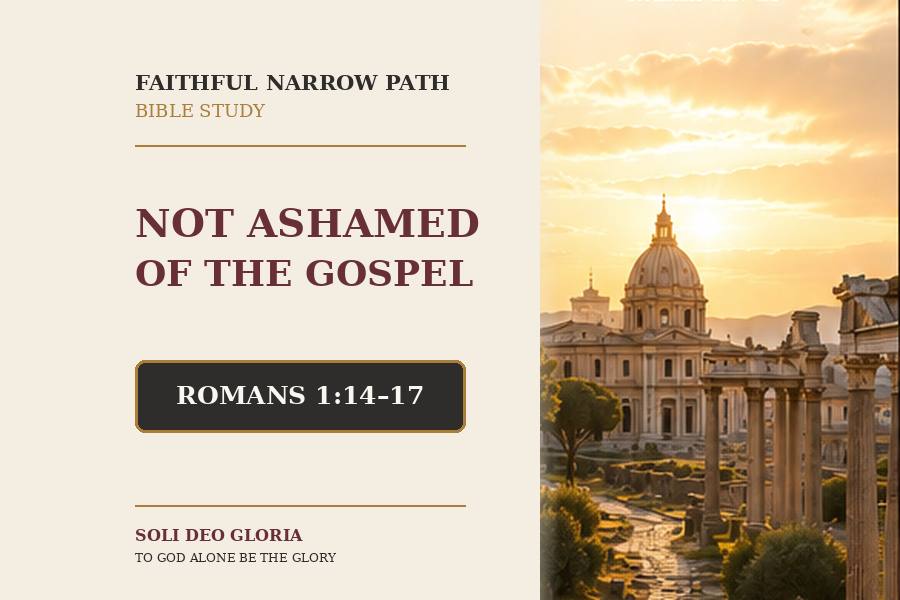
📖 Scripture Reading
Romans 1:14–17 (ESV)
[14] I am under obligation both to Greeks and to barbarians, both to the wise and to the foolish.
[15] So I am eager to preach the gospel to you also who are in Rome.
The Righteous Shall Live by Faith
[16] For I am not ashamed of the gospel, for it is the power of God for salvation to everyone who believes, to the Jew first and also to the Greek.
[17] For in it the righteousness of God is revealed from faith for faith, as it is written, “The righteous shall live by faith.”
🔥 Opening
What gives a person the courage to stand for Christ in a world that often rejects Him?
Many people place their confidence in education, influence, wealth, or personal achievement. Yet none of these can reconcile sinners to a holy God.
The Apostle Paul understood that true hope is found in one message alone: the gospel of Jesus Christ.
Writing to believers in the capital of the Roman Empire, Paul boldly declared:
“I am not ashamed of the gospel.”
In a world that often regarded a crucified Messiah as weakness and foolishness, Paul proclaimed that the gospel is the power of God for salvation.
These verses introduce the central message of Romans. They reveal why Paul preached Christ boldly, why salvation is found in the gospel, and why believers rest in God’s righteousness rather than their own.
Historical Context
Paul wrote Romans around A.D. 57, likely from Corinth during his third missionary journey.
Although he had not yet visited Rome, he longed to strengthen the believers there and hoped eventually to travel farther west.
The church in Rome included both Jewish and Gentile believers. Following the earlier expulsion of Jews from Rome under Emperor Claudius and their later return, tensions could naturally arise within the congregation.
Throughout Romans, Paul establishes that Jew and Gentile alike stand guilty before God and that both are justified in the same way: through faith in Jesus Christ.
Romans 1:16–17 functions as a major theme statement for the letter.
From this foundation, Paul will unfold humanity’s guilt, justification by faith, union with Christ, life in the Spirit, God’s redemptive purposes, and the assurance believers possess in Christ.
Scripture Breakdown
Romans 1:14 – Entrusted With the Gospel
Paul describes himself as being “under obligation.”
He is not speaking of a financial debt.
Christ had entrusted him with the gospel and commissioned him to proclaim it faithfully.
Paul understood that receiving the gospel carried with it a responsibility to make Christ known.
“Greeks and barbarians” points broadly across cultural divisions, while “the wise and the foolish” reaches across social and intellectual distinctions.
The gospel is not reserved for an elite group.
Every person stands in need of God’s saving grace.
Romans 1:15 – Eager to Preach the Gospel
Paul says:
“So I am eager to preach the gospel to you also who are in Rome.”
Significantly, he is writing to Christians.
Believers never graduate from the gospel.
The same message through which God brings sinners to Christ continues to deepen our assurance, humble our pride, strengthen our faith, and shape our lives.
The gospel is not merely the doorway into Christianity.
It remains central to the entire Christian life.
Romans 1:16 – Not Ashamed
“For I am not ashamed of the gospel.”
Paul’s declaration was striking in the ancient Roman world.
Crucifixion was associated with shame, weakness, and humiliation.
Yet Paul knew that what the world regarded as foolishness was God’s appointed means of salvation.
The gospel is not powerful because of human eloquence or persuasive technique.
It is “the power of God for salvation to everyone who believes.”
Paul then says:
“to the Jew first and also to the Greek.”
This reflects the historical unfolding of God’s redemptive plan.
The covenant promises were entrusted to Israel, and through Israel came the promised Messiah.
In Christ, the gospel now goes outward to the nations.
Romans 1:17 – The Righteousness of God Revealed
“For in it the righteousness of God is revealed from faith for faith.”
The gospel reveals the righteousness of God.
Human beings do not possess the righteousness necessary to stand before a holy God.
God graciously provides the righteousness sinners need through Jesus Christ.
This righteousness is received by faith, not earned through human effort.
Paul supports his point by quoting Habakkuk 2:4:
“The righteous shall live by faith.”
This truth becomes foundational for the rest of Romans.
Canonical Context
Romans 1:14–17 stands within the larger story of redemption that runs throughout Scripture.
After humanity’s fall into sin, God promised that the offspring of the woman would ultimately defeat the serpent.
God later promised Abraham that through his offspring all the families of the earth would be blessed.
The prophets continued pointing toward the coming salvation of God.
Habakkuk declared:
“The righteous shall live by his faith.”
Isaiah announced good news and foretold the suffering Servant who would bear the sins of His people.
All of these promises find their fulfillment in Jesus Christ.
The gospel Paul proclaims is not a new religious idea.
It is the fulfillment of God’s redemptive plan revealed throughout Scripture.
Biblical Theology
The gospel is good news because salvation begins with God, not with us.
Human beings stand guilty before a holy God and possess no righteousness of their own that can justify them.
But God has acted.
Jesus Christ lived the righteous life sinners have failed to live, died as a substitute for sin, and rose from the dead.
Through faith in Christ, sinners are justified by grace and reconciled to God.
Romans 3:21–26 later develops this truth in greater detail, showing that God is both just and the justifier of the one who has faith in Jesus.
Romans 5 explains that those who are justified by faith have peace with God.
The gospel therefore does not tell sinners how to earn salvation.
It announces what God has accomplished in Christ.
✝️ Core Truth
Romans 1:14–17 reveals the heart of the Christian message.
The gospel is not advice about how people can earn God’s acceptance.
It is the good news of what God has accomplished through the life, death, and resurrection of Jesus Christ to save sinners.
No one possesses the righteousness required to stand before a holy God.
God graciously provides that righteousness through His Son.
This righteousness is received through faith in Jesus Christ, not earned through human effort.
Because the gospel is God’s power for salvation, believers never leave it behind.
The same gospel that brings us to Christ continues to shape our lives, strengthen our faith, produce holiness, and give us confidence as we await His return.
❤️ Application
Paul was not ashamed of the gospel because he knew that God had appointed it as the means through which sinners are saved.
That same confidence should shape the way we live today.
Our world encourages us to trust in ourselves, our achievements, our possessions, or our own understanding.
The gospel reminds us that our greatest need is not self-improvement.
It is reconciliation with God.
And that reconciliation is found only through Jesus Christ.
As believers, we are called to stand firmly in the gospel even when it is misunderstood or rejected.
We do not need to change God’s message to make it more acceptable.
We faithfully proclaim Christ and trust God to accomplish His purposes through His Word.
If you have never trusted in Jesus Christ, the gospel calls you to turn from sin and place your faith in Him alone.
Forgiveness, reconciliation, and righteousness are found in Christ.
📈 Progress
Paul has introduced the central theme of Romans.
The chapters that follow will explain the gospel in greater depth.
Why does every person stand guilty before God?
How can sinners be declared righteous?
What does it mean to live by faith?
How does the Holy Spirit transform the believer?
What confidence can Christians have in God’s saving purposes?
Each section builds upon the foundation established here:
The gospel is the power of God for salvation to everyone who believes.
🌿 Encouragement
Our confidence is not found in our own strength.
It is found in the God who saves.
When you become discouraged by your failures, remember that your hope rests in Christ’s righteousness rather than your own.
When your faith is tested, remember that the gospel has not lost its power.
When you wonder whether God is still at work, remember that He continues to accomplish His purposes through His Word.
The gospel that brought you to Christ is the same gospel that continues to sustain and shape you.
🤔 Challenge and Reflection
Where does my confidence truly rest?
Am I relying upon my own goodness, accomplishments, or religious activity?
Or am I resting in the righteousness God provides through Jesus Christ?
Am I embarrassed by the gospel when the world considers it foolish?
Do I believe that God’s message is sufficient, or am I tempted to reshape it to gain acceptance?
How can I more faithfully proclaim Christ this week?
🙏 Closing Charge
May we never lose our wonder at the gospel of Jesus Christ.
May we grow in our understanding of God’s Word, delight in His grace, and faithfully proclaim Christ without fear or shame.
May our confidence rest not in ourselves, but in the righteousness God has revealed through His Son.
And may our lives increasingly reflect the transforming power of the gospel.
✝️ Soli Deo Gloria – To God Alone Be the Glory
The gospel begins with God.
He planned redemption.
He sent His Son.
He accomplished salvation through Christ.
He calls sinners to faith.
He preserves His people by grace.
Every sinner who is justified stands before God because of His mercy and the righteousness provided in Christ.
Every ground for human boasting is removed.
To God alone be the glory.
📖 Scriptures Referenced
Primary Passage
Romans 1:14–17
Supporting Scriptures
Genesis 3:15
Genesis 12:1–3
Habakkuk 2:4
Isaiah 52:7
Isaiah 53:4–6
Romans 3:21–26
Romans 5:1–2
Romans 10:9–17
Ephesians 2:8–10
1 Corinthians 1:18–25

Leave a comment