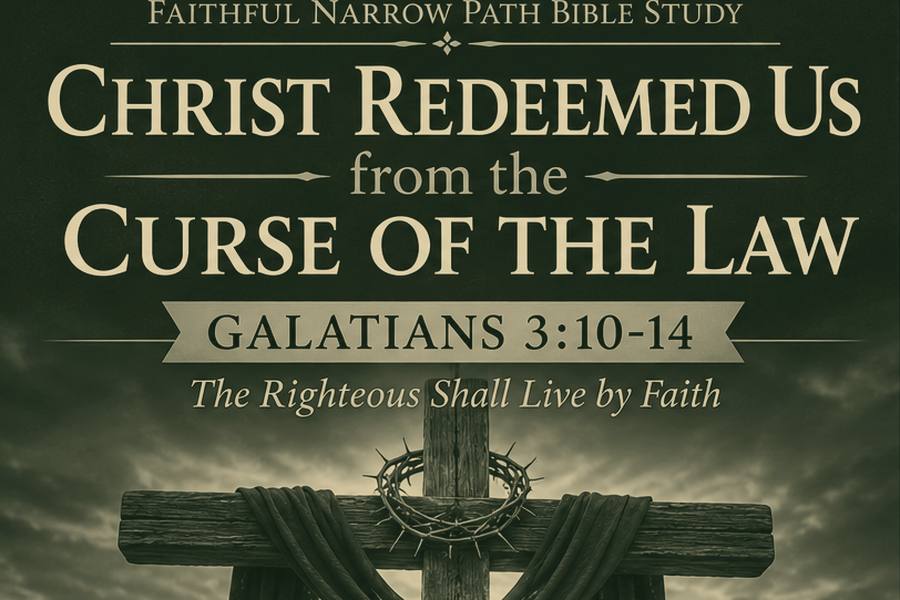
📖 Scripture Reading
Galatians 3:10–14 (ESV)
The Righteous Shall Live by Faith
[10] For all who rely on works of the law are under a curse; for it is written, “Cursed be everyone who does not abide by all things written in the Book of the Law, and do them.” [11] Now it is evident that no one is justified before God by the law, for “The righteous shall live by faith.” [12] But the law is not of faith, rather “The one who does them shall live by them.” [13] Christ redeemed us from the curse of the law by becoming a curse for us—for it is written, “Cursed is everyone who is hanged on a tree”—[14] so that in Christ Jesus the blessing of Abraham might come to the Gentiles, so that we might receive the promised Spirit through faith.
Historical Background
The apostle Paul wrote Galatians to the churches of Galatia to defend the true gospel of Jesus Christ against false teachers who insisted that faith in Christ was not sufficient apart from obedience to certain requirements of the Mosaic Law, particularly circumcision.
The precise date of Galatians and the location of the churches addressed have been debated, but the central historical issue is clear. Teachers had entered the churches insisting that Gentile believers needed to adopt Jewish covenant practices in order to be fully accepted among God’s people.
Paul wrote with urgency because the very heart of the gospel was at stake. Instead of salvation by God’s grace through faith in Christ, the false teachers were adding human works to the basis of acceptance before God. Paul makes clear throughout the letter that altering the gospel in this way does not strengthen it but distorts it (Galatians 1:6-9).
By the time Paul reaches Galatians 3, he appeals directly to the Old Testament Scriptures to demonstrate that justification has always rested upon God’s promise and is received through faith rather than through works of the Law. In verses 10-14, Paul contrasts the curse that falls upon everyone who relies upon obedience to the Law for justification with the redemption accomplished by Jesus Christ, who bore the curse in the place of sinners so that the blessing promised to Abraham might come to Jews and Gentiles through faith.
Understanding this setting is essential for interpreting the passage correctly. Paul is not arguing that God’s Law is sinful or defective. Rather, he demonstrates that the Law cannot justify sinners. It reveals God’s righteous standard, exposes human guilt, and leaves those who depend upon their own obedience under condemnation. Only through the redeeming work of Jesus Christ can sinners be justified, freed from the curse of the Law, and receive God’s promised blessing through faith.
Literary Context
Galatians is Paul’s passionate defense of the gospel of justification by grace alone through faith alone in Jesus Christ. Throughout the letter, he confronts the false teaching that believers must keep the works of the Mosaic Law in order to be fully accepted by God. Paul argues that adding human works to the gospel does not strengthen it but abandons the true gospel altogether (Galatians 1:6-9).
The immediate context begins in Galatians 3:1-9, where Paul reminds the Galatian believers that they received the Holy Spirit by hearing with faith, not by works of the Law. He points to Abraham as the example of justification by faith, demonstrating that God’s promise has always been received through faith rather than through obedience to the Mosaic Law.
Verses 10-14 continue Paul’s argument by explaining why reliance upon the Law can never justify sinners before God. Drawing from several Old Testament passages, Paul demonstrates that everyone who depends upon keeping the Law stands under its curse because the Law demands perfect obedience. In contrast, Jesus Christ bore that curse on behalf of sinners through His death on the cross, redeeming them so that the blessing promised to Abraham might come to both Jews and Gentiles through faith.
This passage stands as one of Scripture’s clearest explanations of the relationship between the Law, the curse of sin, and the redeeming work of Christ. It also prepares the reader for Paul’s continued argument that salvation has always been grounded in God’s promise, fulfilled in Jesus Christ, and received through faith rather than by works of the Law.
Scripture Breakdown
Galatians 3:10-12 – The Curse of Relying on the Law
Paul begins by exposing the impossibility of attaining righteousness through obedience to the Law. He writes, “For all who rely on works of the law are under a curse” (v. 10). His point is not that God’s Law is defective or evil. Rather, the problem lies with sinful humanity. Because the Law requires perfect obedience, everyone who seeks acceptance before God by keeping the Law stands condemned for failing to keep it completely.
To support his argument, Paul quotes Deuteronomy 27:26: “Cursed be everyone who does not abide by all things written in the Book of the Law, and do them.” This quotation demonstrates that partial obedience is insufficient. The Law demands complete and continual obedience, leaving every sinner guilty before a holy God.
Paul then appeals to Habakkuk 2:4, declaring, “The righteous shall live by faith” (v. 11). By quoting the Old Testament itself, Paul demonstrates that justification has never been obtained through obedience to the Law. From the beginning, God has declared righteous those who trust Him by faith.
Finally, Paul quotes Leviticus 18:5: “The one who does them shall live by them” (v. 12).
The Law promises life to the one who perfectly obeys its demands, but fallen sinners cannot meet that standard. Justification therefore cannot come through reliance upon works of the Law. It is received through faith in Jesus Christ.
Paul is not presenting two different ways of salvation. Rather, he contrasts the impossible standard demanded by the Law with the only means by which sinners are justified before God, faith in Jesus Christ.
These verses reveal that the Law was never intended to justify sinners. Instead, it exposes sin, reveals humanity’s inability to attain righteousness through personal obedience, and points every sinner to the Savior who alone fulfills God’s righteous requirements.
Galatians 3:13 – Christ Became a Curse for Us
Having demonstrated that all who rely on the works of the Law stand under its curse, Paul now presents God’s gracious solution. He writes, “Christ redeemed us from the curse of the law by becoming a curse for us” (v. 13).
The word redeemed conveys the idea of being delivered by the payment of a price. Paul declares that Jesus Christ accomplished what the Law could never do. He freed sinners from the Law’s condemnation by bearing its curse in their place.
Paul supports this truth by quoting Deuteronomy 21:23: “Cursed is everyone who is hanged on a tree.”
In its original context, this passage referred to a person who came under God’s judgment. Paul applies this text to the crucifixion of Christ, not because Jesus deserved God’s curse, but because He willingly bore the curse that sinners deserved.
Though completely sinless, Christ stood in the place of His people, taking upon Himself the penalty required by God’s righteous justice.
This verse provides one of Scripture’s clearest expressions of Christ’s substitutionary atonement.
Jesus did not merely sympathize with sinners or provide a moral example. He bore the judgment that belonged to them so that they might be redeemed from the curse of the Law.
At the cross, God’s perfect justice and perfect mercy meet. The penalty for sin was fully satisfied, allowing God to remain both just and the justifier of those who place their faith in Jesus Christ.
Galatians 3:13 reminds us that salvation is entirely the work of Christ.
No amount of obedience to the Law can remove its curse.
Only Jesus Christ, by becoming a curse for sinners, accomplished the redemption they could never achieve for themselves.
His redeeming work opens the way for the blessing Paul describes in the following verse.
Galatians 3:14 – The Blessing of Abraham Through Faith
Paul now explains the purpose of Christ’s redeeming work:
“so that in Christ Jesus the blessing of Abraham might come to the Gentiles, so that we might receive the promised Spirit through faith” (v. 14).
Christ redeemed His people from the curse of the Law not only to remove condemnation but also to bring them into the blessings God had promised long before through His covenant with Abraham.
The “blessing of Abraham” ultimately refers to God’s promise that all nations would be blessed through Abraham’s offspring (Genesis 12:3; 22:18).
Earlier in this chapter, Paul identifies that offspring as Jesus Christ (Galatians 3:16).
Through faith in Christ, both Jews and Gentiles become heirs of God’s promise, not because of obedience to the Mosaic Law, but because of God’s gracious provision through His Son.
Paul also declares that believers “receive the promised Spirit through faith.”
The gift of the Holy Spirit demonstrates that God’s promised salvation has been fulfilled in Christ.
The Spirit is not received by keeping the Law or performing religious works but through faith in Jesus Christ alone.
His presence confirms that believers belong to Christ and share in the blessings of the new covenant.
This verse brings Paul’s argument to its glorious conclusion.
Christ bore the curse of the Law so that God’s promised blessing might extend to all who believe.
From beginning to end, salvation rests upon God’s gracious promise, fulfilled through Jesus Christ and received through faith, not by the works of the Law.
Canonical Context
Paul’s teaching in Galatians 3:10-14 stands at the heart of his argument that sinners are justified by faith in Jesus Christ rather than by the works of the Law.
Throughout the letter, Paul defends the gospel of God’s grace against those who insisted that obedience to the Mosaic Law was necessary for salvation.
This passage demonstrates why such a message cannot save.
The Law exposes humanity’s guilt and pronounces its curse upon every sinner, while Christ alone redeems His people from that curse.
Earlier in Galatians, Paul recounts his conversion and apostolic calling to demonstrate that the gospel he proclaimed came directly from Jesus Christ rather than from human authority (Galatians 1-2).
He then reminds the Galatian believers that they received the Holy Spirit by faith, not by works of the Law, and points to Abraham as the biblical example of justification by faith (Galatians 3:1-9).
Verses 10-14 build upon that foundation by explaining how Christ’s redeeming work fulfills God’s promise and brings the blessing of Abraham to all who believe.
As the letter continues, Paul contrasts the temporary purpose of the Mosaic Law with the permanence of God’s promise fulfilled in Christ (Galatians 3:15-29).
He explains that the Law served as a guardian until Christ came, but now that faith has come, believers are no longer under that guardian.
Through faith in Jesus Christ, all who belong to Him are children of God and heirs according to the promise made to Abraham.
Viewed within the broader message of Galatians, this passage demonstrates that God’s promise, not the Mosaic Law, has always been the foundation of salvation.
Christ fulfilled what the Law could never accomplish by redeeming sinners from its curse so that all who believe might receive the blessings God promised through Abraham.
Biblical Theology
The themes of Galatians 3:10-14 are woven throughout the unfolding story of Scripture.
From the beginning, God has revealed that sinful humanity cannot attain righteousness through personal obedience but must depend upon His gracious provision for salvation.
While the Law reveals God’s holy standard and exposes humanity’s sinfulness, God’s redemptive plan has always rested upon His promise rather than mankind’s ability to keep His commandments perfectly.
The promise first given to Abraham established that all nations would be blessed through his offspring (Genesis 12:1-3; 22:18).
Long before the Mosaic Law was given, God declared Abraham righteous because of his faith (Genesis 15:6).
Paul appeals to these truths throughout Galatians to demonstrate that justification by faith is not a New Testament innovation but has always been central to God’s redemptive plan.
These promises find their fulfillment in Jesus Christ.
As the perfectly obedient Son of God, Christ fulfilled the righteous demands of the Law and bore its curse through His substitutionary death on the cross.
By redeeming sinners from the Law’s condemnation, He secured the blessings God promised to Abraham and opened the way for both Jews and Gentiles to receive forgiveness, justification, adoption into God’s family, and the promised Holy Spirit through faith.
Throughout the New Testament, the apostles consistently proclaim salvation by grace through faith in Jesus Christ apart from the works of the Law (Romans 3:21-28; Ephesians 2:8-9; Philippians 3:7-9).
The Law continues to reveal God’s holiness and humanity’s need for a Savior, but only Christ provides the righteousness required to stand before a holy God.
Viewed within the unfolding story of redemption, Galatians 3:10-14 demonstrates that God’s saving purpose has always been accomplished through His gracious promise, fulfilled in Jesus Christ, and received through faith.
From Abraham to the cross and to the worldwide proclamation of the gospel, Scripture consistently points to Christ as the only Redeemer who delivers sinners from the curse of the Law and brings them into the blessings of God’s covenant promises.
Core Truth
God declares sinners righteous not through obedience to the Law but through faith in Jesus Christ, who redeemed His people from the curse of the Law by bearing that curse in their place.
Salvation has always rested upon God’s gracious promise, fulfilled in Christ and received through faith rather than by human works.
Paul reminds us that the Law reveals God’s holiness and exposes humanity’s inability to attain righteousness through personal obedience.
Left to ourselves, every person stands under the Law’s condemnation because no one can keep it perfectly.
Yet where the Law reveals our guilt, Christ provides our redemption.
By becoming a curse for sinners, He accomplished what the Law could never accomplish, satisfying God’s righteous justice on behalf of all who believe.
The gospel therefore leaves no room for confidence in human effort.
Our hope rests entirely in the finished work of Jesus Christ.
Through faith alone, believers are redeemed from the curse of the Law, declared righteous before God, receive the promised Holy Spirit, and share in the blessing God promised to Abraham.
Application
Paul’s words challenge every believer to examine where they are placing their confidence before God.
Our natural tendency is to rely upon our own efforts, believing that our good works, religious activities, or personal obedience somehow contribute to our acceptance before Him.
Paul leaves no room for such thinking.
If righteousness could be obtained through the Law, Christ’s death would have been unnecessary.
Our only hope is found in the finished work of Jesus Christ.
For believers, this passage is a continual reminder to rest in the sufficiency of the gospel.
While obedience remains an essential response to God’s grace, it is never the basis of our justification.
We obey because we have been saved, not in order to earn God’s favor.
True saving faith is evidenced by a life of growing obedience, not because good works earn our salvation, but because they are the fruit of God’s transforming grace (Ephesians 2:10; James 2:17).
Freed from the curse of the Law, we are now called to live lives of grateful obedience through the power of the Holy Spirit, reflecting the righteousness Christ has already secured for us.
This passage also calls us to guard the purity of the gospel.
Like the Galatians, believers today can be tempted to add human effort, religious traditions, or personal performance to God’s gracious provision in Christ.
Any message that places confidence in human works rather than in Christ alone undermines the sufficiency of His redeeming work and obscures the good news of the gospel.
For those who have not placed their faith in Jesus Christ, this passage offers both a warning and an invitation.
No amount of moral effort or religious observance can remove the curse of sin or make anyone righteous before God.
Left to ourselves, we remain under the condemnation of the Law.
But what we could never accomplish, Jesus Christ accomplished through His death on the cross.
Everyone who repents and places their faith in Him is forgiven, justified, redeemed from the curse of the Law, and welcomed into God’s family.
Progress
In this passage, Paul has demonstrated that no one can be justified by the works of the Law because all who rely upon it stand under its curse.
But through His substitutionary death, Jesus Christ redeemed His people from that curse so that the blessing promised to Abraham might come to all who believe through faith.
As Galatians continues, Paul expands upon the relationship between God’s promise and the Mosaic Law.
He explains that God’s covenant with Abraham was established by promise long before the Law was given and therefore cannot be nullified by it (Galatians 3:15-18).
Paul then reveals the temporary purpose of the Law as a guardian until the coming of Christ (Galatians 3:19-29), emphasizing that all who belong to Christ are children of God through faith and heirs according to the promise.
Encouragement
The good news of the gospel is that our standing before God does not rest upon our imperfect obedience but upon the perfect obedience and finished work of Jesus Christ.
Though the Law exposes our sin and reminds us of our need for a Savior, it also points us to the One who has redeemed His people from its curse and secured their salvation through His death and resurrection.
If you are trusting in Christ, take heart.
Your acceptance before God is not based upon your performance but upon the righteousness of Christ, credited to you through faith.
Because He has borne the curse you deserved, you are no longer under condemnation but have been reconciled to God and made an heir of His promises.
Let this truth strengthen your faith, deepen your gratitude, and encourage your obedience.
As you rest in Christ’s finished work, walk confidently in the power of the Holy Spirit, knowing that the God who redeemed you is faithful to keep every promise He has made.
Your hope rests not in what you have done for Christ, but in what Christ has accomplished for you.
Challenge & Reflection
As you reflect on this passage, ask yourself:
Am I trusting completely in the finished work of Jesus Christ for my acceptance before God, or am I still relying upon my own efforts, religious activities, or personal righteousness?
Do I rest confidently in the truth that Christ has redeemed me from the curse of the Law, or do I allow guilt, fear, or self-reliance to overshadow the freedom found in the gospel?
Does my life bear the fruit of genuine faith through grateful obedience, demonstrating the transforming work of God’s grace within me?
Am I faithfully pointing others to salvation by grace through faith in Jesus Christ alone, or am I allowing human effort or religious performance to obscure the sufficiency of the gospel?
Having been redeemed from the curse of the Law through Jesus Christ, may we rest confidently in His finished work, walk by faith, and joyfully live in the freedom, assurance, and obedience that flow from God’s saving grace alone.
Closing Charge
May we never place our confidence in our own righteousness or in the works of the Law, but in the finished work of Jesus Christ, who redeemed His people from the curse of the Law by bearing that curse in their place.
Let us rest fully in His sufficient work and rejoice in the salvation God has graciously provided through Him.
As those who have been justified by faith and reconciled to God through Christ, may we walk in grateful obedience, empowered by the Holy Spirit, bearing the fruit of genuine faith and proclaiming the gospel of grace with humility and boldness.
May our lives continually testify that salvation is by grace alone, through faith alone, in Christ alone.
May Christ be exalted, His gospel faithfully proclaimed, His church strengthened, and God alone receive the glory.
✝️ Soli Deo Gloria – To God Alone Be the Glory
To God alone be the glory.
📚 Scriptures Referenced
Primary Passage
Galatians 3:10-14
Historical Background
Galatians 1:6-9
Galatians 3:1-14
Literary Context
Galatians 1:6-9
Galatians 3:1-9
Galatians 3:15-29
Scripture Breakdown
Deuteronomy 27:26
Habakkuk 2:4
Leviticus 18:5
Deuteronomy 21:23
Genesis 12:3
Genesis 22:18
Galatians 3:16
Canonical Context
Galatians 1-2
Galatians 3:1-9
Galatians 3:15-29
Biblical Theology
Genesis 12:1-3
Genesis 15:6
Genesis 22:18
Romans 3:21-28
Ephesians 2:8-10
Philippians 3:7-9
Application
Ephesians 2:10
James 2:17
Progress
Galatians 3:15-29

Leave a comment