Scripture Reading
Matthew 7:24–29 (ESV)
Build Your House on the Rock
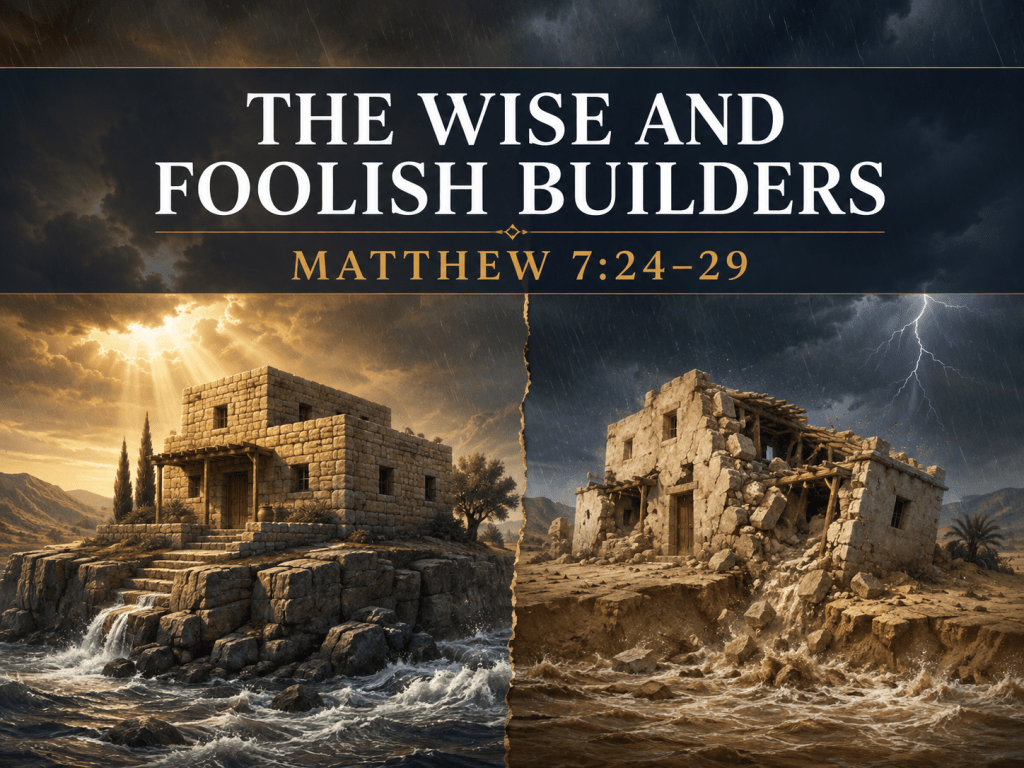
[24] “Everyone then who hears these words of mine and does them will be like a wise man who built his house on the rock. [25] And the rain fell, and the floods came, and the winds blew and beat on that house, but it did not fall, because it had been founded on the rock. [26] And everyone who hears these words of mine and does not do them will be like a foolish man who built his house on the sand. [27] And the rain fell, and the floods came, and the winds blew and beat against that house, and it fell, and great was the fall of it.”
The Authority of Jesus
[28] And when Jesus finished these sayings, the crowds were astonished at his teaching, [29] for he was teaching them as one who had authority, and not as their scribes.
Opening
Everyone is building a life on something.
Some build on success, relationships, financial security, personal achievement, identity, or the approval of others. Some rely upon religious knowledge, church involvement, or familiarity with the Bible. Others assume that hearing biblical truth is enough to prepare them for the pressures of life and the judgment to come.
As Jesus concludes the Sermon on the Mount, He presents His listeners with a sobering illustration: two builders, two foundations, one storm, and two completely different outcomes.
The two builders share several similarities. Both hear the words of Jesus. Both build a house. Both experience the same storm. From the outside, their houses may have appeared equally secure.
The decisive difference lies beneath the surface.
One builder hears Christ’s words and acts upon them. The other hears the same words but does not obey them. One house stands because it has been founded upon rock. The other falls because it has been built upon sand.
The storm does not create the difference between the foundations. It reveals the difference that was already there.
Jesus’ warning therefore reaches far beyond managing the ordinary hardships of life. Within the conclusion of the Sermon on the Mount, the storm ultimately points toward the final testing of every life before God. Jesus is calling His listeners to examine whether they have truly received His words with the obedient faith that characterizes genuine discipleship.
Historical and Literary Context
Matthew 7:24–29 concludes the Sermon on the Mount recorded in Matthew 5–7. Throughout the sermon, Jesus teaches with divine authority concerning the kingdom of heaven, true righteousness, prayer, relationships, possessions, judgment, and faithful obedience to God.
The words “everyone then” in verse 24 connect this illustration to everything Jesus has taught throughout the sermon. Jesus is not referring only to the parable itself. He is calling His listeners to respond to “these words of mine”—the authoritative teaching He has just delivered.
The immediate context is especially important. In Matthew 7:13–23, Jesus presents a series of solemn contrasts:
• A narrow gate and a wide gate
• A difficult way and a broad way
• Good trees and bad trees
• True disciples and false professors
• Those whom Christ knows and those He rejects
The wise and foolish builders form the final contrast in this sequence. Jesus is not merely comparing prudent and imprudent approaches to life. He is revealing the difference between those who truly respond to Him and those who hear His teaching without submitting to His authority.
The passage concludes by describing the crowd’s response. They were astonished because Jesus taught with authority and not as their scribes. The scribes commonly appealed to earlier teachers and traditions, but Jesus repeatedly declared, “I say to you.” He did not present Himself merely as another interpreter of God’s Word. He spoke with authority belonging uniquely to Him.
Therefore, this passage concerns more than wise decision-making. It confronts every hearer with the authority of Jesus Christ and the necessity of responding faithfully to His words.
Scripture Breakdown
Matthew 7:24–25 — The Wise Builder
Jesus begins, “Everyone then who hears these words of mine and does them will be like a wise man who built his house on the rock.”
The wise builder does two things: he hears Christ’s words and acts upon them.
Hearing is necessary, but hearing alone is not sufficient. The wise builder receives Christ’s teaching as authoritative and responds with obedient faith. His obedience does not earn salvation or make him worthy of God’s grace. Rather, it demonstrates that Christ’s words have been genuinely received.
The foundation is established before the storm arrives. Digging down to rock would have required greater effort, patience, and foresight than building quickly upon the sand. For a time, the difference between the two houses may not have been apparent. Only when the rain, floods, and winds arrived did the true condition of each foundation become visible.
The wise builder’s confidence is not ultimately in his construction ability, personal strength, or moral performance. His life is established upon the words and authority of Jesus Christ.
When the storm strikes, the house remains standing—not because the storm is weak, but because the foundation is secure.
Matthew 7:26–27 — The Foolish Builder
Jesus then describes the foolish builder: “Everyone who hears these words of mine and does not do them will be like a foolish man who built his house on the sand.”
The foolish builder also hears Christ’s words. His problem is not a lack of exposure to the truth. His failure is hearing without responding.
He possesses information without submission. He may recognize the truth, admire the teaching, or even appear outwardly religious, yet he refuses to build his life upon Christ’s words.
Building upon sand may have appeared easier. It required less preparation and allowed visible progress to occur quickly. The house may have appeared stable while conditions remained favorable.
But appearances cannot withstand testing forever.
The same rain falls. The same floods rise. The same winds strike. Unlike the house founded upon rock, however, the foolish builder’s house collapses.
Jesus emphasizes the severity of the outcome: “great was the fall of it.”
This is not merely a warning that ignoring biblical wisdom can make life more difficult. Within the surrounding context, Jesus is warning that hearing His words without responding in obedient faith will not withstand God’s final judgment.
Religious familiarity cannot substitute for genuine discipleship. Knowing the words of Jesus while refusing His authority leaves a person upon an unstable foundation.
Matthew 7:28–29 — The Authority of Jesus
Matthew concludes the Sermon on the Mount by recording the crowd’s astonishment.
Jesus taught “as one who had authority, and not as their scribes.” His authority is central to the entire passage. The eternal outcome of each builder depends upon how that person responds to the words of Jesus.
This is an extraordinary claim. Jesus does not tell the crowd merely to build upon wisdom in general. He declares that everything depends upon hearing and obeying “these words of mine.”
The crowds recognize that His teaching differs from that of their customary teachers. Jesus speaks with direct, personal, and divine authority. His words demand more than admiration; they demand a response.
The question raised by the passage is therefore not simply, “Will I make wise decisions?” The deeper question is, “How will I respond to the authoritative words of Jesus Christ?”
Supporting Scripture
James reinforces this same truth:
“But be doers of the word, and not hearers only, deceiving yourselves.”
James 1:22 (ESV)
James 1:22–25 compares a person who hears without responding to someone who looks at his face in a mirror, walks away, and immediately forgets what he saw. By contrast, the person who looks into God’s Word, perseveres, and becomes a doer who acts will be blessed in his doing.
James is not teaching that people earn salvation through their works. He is warning against the self-deception of claiming to receive God’s Word while consistently refusing to respond to it.
Jesus and James teach the same essential principle: genuine faith does not remain merely intellectual or verbal. When God’s Word is truly received, it produces a life increasingly marked by trust, repentance, and obedience.
Biblical and Canonical Context
Within the immediate context of Matthew 7, building upon the rock means hearing and obeying the authoritative words of Jesus. As we consider this teaching within the broader testimony of Scripture, we also recognize that Jesus Christ Himself is the only secure foundation for salvation and eternal life.
Paul writes:
“For no one can lay a foundation other than that which is laid, which is Jesus Christ.”
1 Corinthians 3:11 (ESV)
These truths belong together. We are not saved because we have obeyed perfectly. No one except Jesus Christ has perfectly fulfilled God’s righteous requirements.
Salvation is entirely by God’s grace through faith in Christ. Jesus lived the sinless life we could never live, died as the once-for-all sacrifice for sin, and rose bodily from the dead. Everyone who repents and trusts in Him receives forgiveness and eternal life—not as a reward for good works, but as a gift of God’s grace.
However, the faith that receives Christ does not leave a person unchanged. Genuine faith produces the fruit of obedience because God gives His people new hearts and works within them through the Holy Spirit.
Obedience is therefore not the foundation of our acceptance before God. Jesus Christ is that foundation. Obedience is the necessary fruit and evidence of a life that has truly been founded upon Him.
This distinction protects us from two opposite errors. We must not believe that our works earn salvation, but neither should we imagine that genuine faith can remain permanently indifferent to Christ’s commands.
The Meaning of the Storm
This passage is often applied to the storms and difficulties of ordinary life. That is a reasonable secondary application. Trials can expose what we truly believe, where our confidence rests, and whether God’s Word has taken root within us.
However, the immediate context points beyond temporary hardships. Jesus has just warned about the broad road leading to destruction, bad trees being cut down and thrown into the fire, and false disciples being rejected on the final day.
The storm therefore represents the decisive testing of God’s judgment. Every life will ultimately be exposed. Outward appearances, religious knowledge, and verbal professions will not provide a secure foundation.
Only those who truly belong to Christ will stand.
The passage certainly encourages believers to rely upon Christ through present difficulties, but its central warning is more serious: every person must be prepared to stand before God.
Core Truth
A life truly founded upon Jesus Christ receives His words with obedient faith and will stand when every foundation is finally tested.
Application
This passage invites personal examination rather than comparison.
The question is not whether we can identify foolish builders around us. The question is whether our own lives are genuinely founded upon Christ.
For those who already profess faith in Jesus:
• Am I content merely to know God’s Word, or am I submitting to it?
• Has Christ’s teaching taken root in the way I live?
• Do I obey only when obedience is convenient?
• Is my confidence resting in religious familiarity, church activity, or Christ Himself?
• Where is God presently calling me to respond faithfully to His Word?
For those exploring Christianity or uncertain where they stand with God:
• What foundation am I building my life upon?
• If everything I presently trust were removed, what would remain?
• Have I merely heard the claims of Jesus, or have I seriously considered His authority?
• Have I trusted Christ for the forgiveness and new life that only He can provide?
The foundation Christ offers cannot be earned through good works. It is received by grace through faith in Him. His invitation remains open to everyone who will repent, believe the gospel, and come to Him.
Progress
Spiritual maturity is often built quietly through daily faithfulness.
A strong foundation is usually formed before the storm becomes visible. Prayer, careful study of Scripture, participation in the life of a faithful church, repentance from sin, love for others, and ordinary acts of obedience may not appear dramatic. Yet God uses these means to establish His people more firmly in Christ.
Every genuine act of obedience reflects a heart being shaped by God’s Word.
Growth will not be perfect in this life. Believers still struggle with sin, weakness, fear, and inconsistency. Our security rests in Christ, not in flawless performance.
Nevertheless, where genuine faith exists, God continues His sanctifying work. Over time, His Word produces recognizable fruit in our beliefs, priorities, relationships, desires, and conduct.
Storms do not determine whether a foundation exists. They reveal what was there all along.
Encouragement
Christ does not merely command us to build upon a secure foundation and then leave us to accomplish it in our own strength.
The believer’s hope is not found in living a perfect life. Our hope is found in a perfect Savior. Jesus lived the sinless life we could never live, gave Himself for our sins, rose from the dead, and now intercedes for His people.
Through the Holy Spirit, God continues transforming those who trust in Christ from the inside out.
Obedience is not the means of earning God’s love. It is the fruit of having received His grace. When believers stumble, Christ remains faithful. He calls us to confess our sin, return to Him, and continue walking by faith.
If present trials have exposed weakness in your faith, do not run away from Christ. Run to Him. Allow His Word to uncover what needs to change, and trust Him to continue the work He has begun.
Our confidence is not in our ability to withstand every storm. It is in the One who cannot be shaken.
Challenge and Reflection
Take time to consider these questions prayerfully:
• When pressure exposes my heart, what does it reveal?
• Am I building upon convenience or conviction?
• Do I receive Christ’s words as authoritative over every area of my life?
• Am I relying upon religious knowledge without obediently responding?
• Is there a command of Christ I have been resisting or postponing?
• Is my assurance based upon my own goodness, or upon Christ and His finished work?
• What practical step of faithful obedience should I take today?
Bring your answers honestly before God. Ask Him to expose every false foundation, deepen your trust in Christ, and give you grace to receive and obey His Word.
Closing Charge
Jesus concludes the Sermon on the Mount by placing a decision before every hearer.
Every person is building.
Every foundation will eventually be tested.
The wise are not those who merely hear Christ’s words, admire His teaching, or possess religious knowledge. The wise are those who receive His words through a genuine faith that produces the fruit of obedience.
Do not wait for the storm to examine your foundation.
Come to Christ. Trust His finished work. Receive His Word. Submit to His authority. Build your life upon the only foundation that will stand.
May we not be hearers only, but faithful followers whose lives remain secure because they have been founded upon Jesus Christ.
Soli Deo Gloria
To God Alone Be the Glory
The strength of the wise builder was never ultimately found in the builder himself, but in the security of the foundation upon which he built.
Our hope is not in our goodness, knowledge, consistency, or ability to withstand every difficulty. Our hope is Jesus Christ.
He is the only Savior, the only secure foundation, and the only One who can prepare us to stand before God.
If you have trusted in Christ, continue building upon Him through faithful dependence upon His Word. When you fall, return to Him in repentance. When you are weak, rely upon His strength. When the storms come, remember that your security rests not in the strength of your grip upon Christ but in the faithfulness of the Savior who holds you.
If you have never trusted in Christ, consider His invitation today. The foundation He offers cannot be purchased through good works or religious achievement. Salvation is received by grace through faith in Him.
No other foundation will stand when the storms of life—and ultimately the judgment of God—come.
“For no one can lay a foundation other than that which is laid, which is Jesus Christ.”
1 Corinthians 3:11 (ESV)
To God alone be the glory.
Scriptures Referenced
Primary Passage
Matthew 7:24–29
Immediate Literary Context
Matthew 5:1–7:29
Matthew 7:13–23
Supporting Scripture
James 1:22–25
1 Corinthians 3:11

Leave a comment