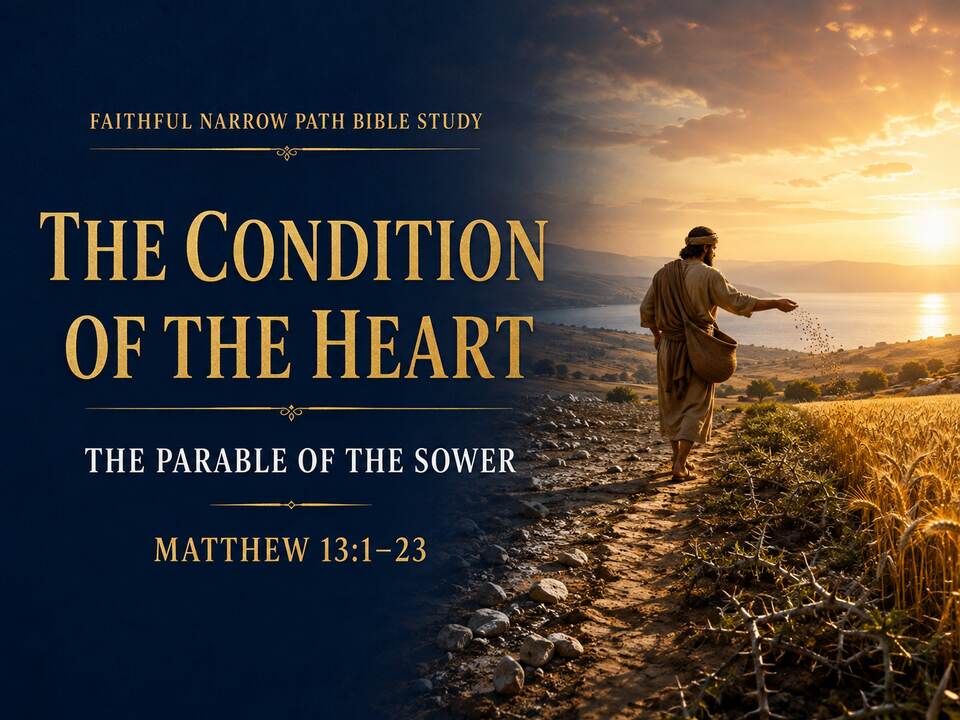
Scripture Reading
Matthew 13:1–23 (ESV)
The Parable of the Sower
[1] That same day Jesus went out of the house and sat beside the sea. [2] And great crowds gathered about him, so that he got into a boat and sat down. And the whole crowd stood on the beach. [3] And he told them many things in parables, saying:
“A sower went out to sow. [4] And as he sowed, some seeds fell along the path, and the birds came and devoured them. [5] Other seeds fell on rocky ground, where they did not have much soil, and immediately they sprang up, since they had no depth of soil, [6] but when the sun rose they were scorched. And since they had no root, they withered away. [7] Other seeds fell among thorns, and the thorns grew up and choked them. [8] Other seeds fell on good soil and produced grain, some a hundredfold, some sixty, some thirty. [9] He who has ears, let him hear.”
The Purpose of the Parables
[10] Then the disciples came and said to him, “Why do you speak to them in parables?”
[11] And he answered them, “To you it has been given to know the secrets of the kingdom of heaven, but to them it has not been given. [12] For to the one who has, more will be given, and he will have an abundance, but from the one who has not, even what he has will be taken away. [13] This is why I speak to them in parables, because seeing they do not see, and hearing they do not hear, nor do they understand. [14] Indeed, in their case the prophecy of Isaiah is fulfilled that says:
‘You will indeed hear but never understand,
and you will indeed see but never perceive.’
[15] For this people’s heart has grown dull,
and with their ears they can barely hear,
and their eyes they have closed,
lest they should see with their eyes
and hear with their ears
and understand with their heart
and turn, and I would heal them.
[16] But blessed are your eyes, for they see, and your ears, for they hear. [17] For truly, I say to you, many prophets and righteous people longed to see what you see, and did not see it, and to hear what you hear, and did not hear it.”
The Parable of the Sower Explained
[18] “Hear then the parable of the sower: [19] When anyone hears the word of the kingdom and does not understand it, the evil one comes and snatches away what has been sown in his heart. This is what was sown along the path.
[20] As for what was sown on rocky ground, this is the one who hears the word and immediately receives it with joy, [21] yet he has no root in himself, but endures for a while, and when tribulation or persecution arises on account of the word, immediately he falls away.
[22] As for what was sown among thorns, this is the one who hears the word, but the cares of the world and the deceitfulness of riches choke the word, and it proves unfruitful.
[23] As for what was sown on good soil, this is the one who hears the word and understands it. He indeed bears fruit and yields, in one case a hundredfold, in another sixty, and in another thirty.”
Historical and Literary Context
Jesus taught this parable while large crowds gathered around Him beside the Sea of Galilee. Because the crowd had become so large, He entered a boat and taught while the people stood along the shore.
The agricultural imagery would have been immediately familiar to His original audience. A sower scattering seed across a field was a common sight in first-century Galilee. Seed could fall upon hardened paths, shallow rocky ground, areas containing thorns, or soil that had been properly prepared.
After presenting the parable publicly, Jesus explained its meaning to His disciples. The seed represents the Word concerning the kingdom, while the different soils represent the various ways people hear and respond to that Word.
Jesus also makes clear that physical hearing does not automatically produce spiritual understanding. Many people heard His words, but not everyone received the truth with a heart prepared to understand, believe, and bear fruit.
The parable therefore concerns more than different reactions to a religious message. It reveals the spiritual condition of the heart and demonstrates that genuine reception of God’s Word ultimately produces lasting fruit.
Scripture Breakdown
Jesus explains that the seed represents the Word of God and that the soils represent the different responses of those who hear it.
The seed itself does not change. God’s Word remains true and powerful. What differs is the condition of the heart receiving it.
Jesus also makes clear that spiritual understanding is not automatic. Those who are given ears to hear receive and understand the truth, while those who continually reject it remain hardened toward it.
The Hard Soil
Some seed falls along the path. The ground is hard and compacted. The seed cannot penetrate the soil and is quickly taken away.
Jesus explains that this represents those who hear the Word but do not understand it. The evil one comes and snatches away what was sown in the heart.
The issue is not the power of the Word but the condition of the heart. Repeated resistance can produce spiritual hardness in which truth is heard but never received.
The Rocky Soil
Some seed falls on rocky ground. The soil is shallow, so the seed springs up quickly. There is an immediate response and visible growth.
But when trouble or persecution comes because of the Word, the plant withers because it has no root.
Jesus says this represents those who receive the Word with joy but have no depth. Their response may be genuine in emotion, but it is not rooted deeply enough to endure hardship.
This shows that enthusiasm alone is not the same as lasting faith.
The Thorny Soil
Some seed falls among thorns. The plant begins to grow, but it is gradually choked.
Jesus identifies the thorns as the cares of the world and the deceitfulness of riches. Mark’s parallel account also mentions desires for other things.
The Word is not rejected outright. It is crowded out. Spiritual growth is slowly suffocated by competing priorities, worldly concerns, and misplaced desires.
The result is a life that ultimately proves unfruitful.
The Good Soil
Some seed falls on good soil. It takes root, grows, and produces a harvest.
Jesus says this represents the person who hears the Word, understands it, and receives it. The evidence of genuine reception is lasting fruit.
The amount of fruit varies. Some produce a hundredfold, some sixty, and some thirty. The quantity is not identical, but every example of good soil produces fruit.
Core Truth
The response to God’s Word reveals the condition of the heart, and genuine reception of the Word produces lasting fruit.
Application
Jesus did not give this teaching for observation only. He gave it for examination.
The question is not merely what kind of soil other people are. The question is:
What kind of soil are we?
Have we become hardened toward truth we repeatedly hear?
Have we responded emotionally but failed to develop depth?
Have distractions, pressures, worldly concerns, or competing desires crowded out our devotion to God?
Or is the Word taking root and producing visible fruit over time?
Hearing alone is not the goal. Receiving, understanding, and responding to God’s Word is.
Progress
Spiritual growth is often gradual, but it is real wherever the Word takes root.
Fruit does not appear instantly, but it becomes visible over time.
A life shaped by God’s Word will increasingly demonstrate changes in priorities, desires, attitudes, conduct, and obedience.
The harvest may differ from one believer to another, but the presence of fruit is evidence that the Word has been genuinely received.
Where there is no fruit, there is reason for honest and prayerful reflection.
Encouragement
God’s Word is living and active. It does not return empty.
The same Word that exposes the condition of the heart is also used by God to transform the heart.
God is faithful to produce growth where His Word is genuinely received.
Even small beginnings of spiritual fruit can provide evidence of His gracious work.
Challenge and Reflection
What kind of soil best describes your present response to God’s Word?
Where do you see resistance, shallowness, or distraction in your life?
Are worldly concerns, financial desires, entertainment, personal ambitions, or other priorities beginning to crowd out your devotion to God?
Where do you see evidence that God’s Word is taking root and producing fruit?
What truth has God shown you that now requires a faithful response?
Closing Charge
Jesus repeats this emphasis throughout the teaching:
“He who has ears, let him hear.”
Matthew 13:9
Mark 4:9
Luke 8:8
This is not a passing statement. It is a direct call to attentive, understanding, and responsive hearing of God’s Word.
That call still stands today.
Do not be content merely to hear God’s Word. Receive it. Submit to it. Allow it to take root deeply within your heart.
May we be people who not only listen to the Word but also bear fruit through it, bringing glory to God and demonstrating the transforming power of His truth.
Soli Deo Gloria
To God Alone Be the Glory
The seed is always the same. The Word of God is perfect, living, and unchanging.
The difference is never in the message but in the heart that receives it.
Only God can take what is hardened, shallow, or distracted and make it receptive to His truth. Only He can bring life where there was none and produce lasting fruit where there was once resistance.
A fruitful life is not the result of perfect human effort. It is the result of a heart made receptive by the grace of God and sustained by His Word.
If the Word is bearing fruit in your life, it is evidence of His work within you.
If it is not, the call is not simply to try harder but to come honestly before God and ask Him to prepare your heart.
Jesus is not only the One who sows the seed. He is the One who gives life, growth, and fruit that endures.
“For we are God’s fellow workers. You are God’s field, God’s building.” 1 Corinthians 3:9 (ESV)
To God alone be the glory.
Scriptures Referenced
Primary Passage
Matthew 13:1–23
Parallel Accounts
Mark 4:1–20
Luke 8:4–15
Additional Scripture
1 Corinthians 3:9

Leave a comment